 注: 建议图片大小150px*50px
丨
English
注: 建议图片大小150px*50px 


Views: 0 Author: Site Editor Publish Time: 2026-06-14 Origin: Site


Bridge construction and maintenance present unique access challenges. Tasks like painting, cable inspection, and deck underside repairs often render traditional ground-up scaffolding completely unfeasible. Deep water, heavy traffic, and extreme heights make conventional ground support impossible.
Procurement and project managers face a difficult balancing act. You must minimize the equipment footprint on site. You also need to ensure worker safety in volatile, high-wind environments. Strict project timelines add further pressure to these complex site logistics.
A temporary hanging work system solves these distinct challenges. Specifically, an engineered Suspended Platform addresses these strict operational constraints. It delivers safe, efficient vertical access without unnecessarily blocking valuable traffic lanes below. This guide breaks down how you can evaluate, select, and safely deploy suspended access equipment for major bridge infrastructure projects.
Choosing the right access equipment significantly impacts overall project logistics. Traditional fixed scaffolding requires massive material transport. Crews spend weeks erecting these heavy structures from the ground up. This method consumes enormous physical space. It often forces extended traffic lane closures. It also risks disrupting busy commercial waterways.
Temporary suspended systems offer a rapid deployment alternative. Crews install suspension mechanisms directly on the bridge deck or parapet. This top-down approach eliminates ground-level interference entirely. You avoid complex permitting issues associated with blocking navigable rivers.
Operational efficiency increases dramatically. Motorized hoist systems allow workers to adjust their vertical position instantly. Personnel reach specific work zones faster. They position heavy repair tools precisely where needed. This eliminates the slow, exhausting process of climbing extensive scaffold stairs. Reduced fatigue directly translates into higher daily productivity.
You must define what a successful deployment actually looks like before procurement begins. Evaluate your project against these primary success metrics:
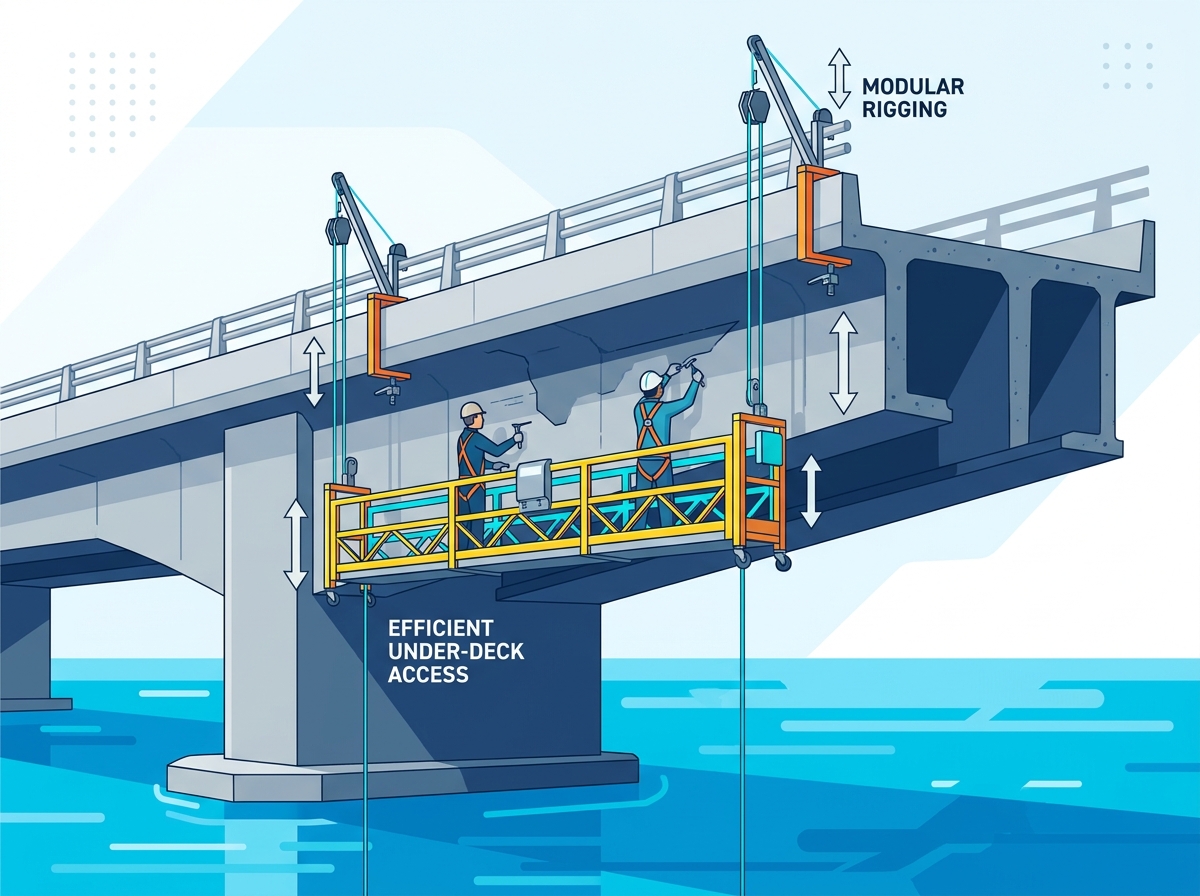
Bridge designs vary wildly. Suspension bridges, cable-stayed structures, and standard concrete overpasses require different access approaches. You must select the precise platform architecture suited to your specific structural geometry.
The standard ZLP Suspended Platform serves as the workhorse for vertical bridge structures. Contractors deploy them frequently on towering pylons and massive concrete piers. These platforms travel vertically along straight structural faces. They excel during concrete pouring, surface patching, and routine painting.
Standard load capacities typically range from 500kg to 800kg. This supports multiple workers alongside heavy power tools. High-performance traction hoists provide reliable climbing power. These hoists handle long vertical drops smoothly. They maintain consistent ascent speeds even when carrying maximum rated loads.
Complex bridges demand high adaptability. An Industrial Modular Suspended Platform delivers this flexibility. Manufacturers design these systems using interchangeable sections. You can connect 1-meter, 2-meter, and 3-meter segments together.
Contractors assemble specific platform lengths on site. This allows crews to navigate safely around intrusive bridge cables. You can build a shorter platform to fit inside tight archways. Alternatively, you can assemble a long continuous platform to cover wide sections of the deck underside. This modularity prevents you from buying multiple custom platforms.
Bridges endure constant vibration from passing traffic. Coastal bridges experience intense wind loads. Conventional bolted joints sometimes loosen under these relentless forces. The Hanging Pin Style Suspended Platform solves this mechanical vulnerability.
This system replaces standard bolts with heavy-duty steel pins. Pin connections offer a distinct mechanical advantage. They resist vibration-induced loosening completely. They also drastically reduce assembly times on site. Workers simply slide the pins into place and secure them using cotter clips. Disassembly happens just as quickly when relocating the platform.
Weight limits often dictate equipment choices on older infrastructure. An Aluminum Suspended Platform offers an exceptional weight-to-strength ratio. Aluminum weighs significantly less than traditional steel.
This lighter structural load protects delicate bridge parapets from excessive stress. Furthermore, aluminum provides natural corrosion resistance. This makes it the ideal choice for over-water or coastal bridge projects. Saltwater spray degrades unprotected steel rapidly. Aluminum withstands harsh marine environments naturally. This preserves structural integrity over long maintenance campaigns.
| Platform Type | Primary Bridge Application | Key Environmental Advantage | Typical Load Range |
|---|---|---|---|
| ZLP Steel Series | Tall pylons, vertical concrete piers | High impact resistance | 630kg - 1000kg |
| Modular Design | Cable-stayed gaps, tight archways | High geometric adaptability | 500kg - 800kg |
| Pin Connection Style | High-traffic decks, windy gorges | Vibration and wind resistance | 630kg - 800kg |
| Aluminum Series | Coastal zones, fragile historic parapets | Corrosion resistance, low dead weight | 500kg - 800kg |
Selecting reliable equipment requires rigorous technical evaluation. You cannot rely on guesswork when suspending crews hundreds of feet above a river. Assess these specific operational dimensions.
You must calculate the total required capacity accurately. Do not just weigh the personnel. Factor in heavy power tools, sandblasting equipment, and bulky repair materials. For example, concrete repair mortar adds immense weight quickly. Choose hoists capable of lifting your maximum calculated load plus a 20% safety buffer. Verify hoist traction mechanisms ensure zero rope slippage during wet conditions.
The suspension mechanism matters just as much as the platform itself. You must evaluate the bridge deck design. Solid concrete parapets might safely support specialized parapet clamps. These clamps deploy quickly and save deck space. However, fragile or angled parapets require custom suspension jibs. These jibs sit back on the main deck. They utilize heavy counterweights to balance the platform hanging over the edge.
Bridges span massive distances. Running power lines from a central source creates severe voltage drops. Long electrical cables increase resistance. If voltage drops too low, hoist motors overheat and burn out. You must assess power delivery realistically. Determine if you will tie into an existing grid or run portable generators. If using generators, size the electrical cables correctly to guarantee stable voltage across long spans.
Wind poses the greatest operational threat during bridge access. Strong gusts cause platforms to sway dangerously. Evaluate the sway control mechanisms offered by the manufacturer. Look for specialized wall rollers or independent tethering lines. Furthermore, establish acceptable wind-speed thresholds clearly. Standard operations must halt when wind speeds exceed safe manufacturer limits.
Working at extreme heights leaves zero room for mechanical failure. You must prioritize absolute safety through equipment design and rigorous compliance.
A single point of failure must never cause a catastrophic drop. True redundancy is an absolute necessity. The system must feature independent safety wire ropes entirely separate from the main lifting ropes. If a lifting rope snaps, the safety rope takes the load instantly. Anti-tilt safety locks represent another critical layer. These mechanical locks engage automatically if the platform tilts beyond a few degrees. Finally, hoist motors must include automatic emergency braking mechanisms activated by sudden speed increases.
Human error sometimes leads to overloaded platforms. Crews might load too much material. Advanced platforms integrate sensitive load sensors. These sensors monitor weight continuously. If the platform exceeds its rated capacity, the sensor trips a contactor. This prevents the hoist motor from lifting. The system only resumes operation once crews remove the excess weight.
Never procure equipment lacking proper documentation. Baseline regulatory requirements exist to protect your workforce. Ensure the equipment carries legitimate CE marking or meets strict OSHA standards. Verify the manufacturer operates under ISO 9001 quality management systems. Regional safety authority approvals prove the equipment passed independent third-party testing.
The platform protects workers, but independent safety measures remain vital. Address operator risk factors aggressively. Require all personnel to wear full-body harnesses. Workers must tie their fall arrest lanyards to independent vertical lifelines. They must never tie off directly to the platform structure. If the platform fails entirely, the independent lifeline catches the worker safely.
Great equipment fails if implemented poorly. Proper rollout requires systematic inspection, skilled rigging, and aggressive maintenance routines.
Daily inspections prevent subtle issues from becoming fatal accidents. Implement a rigid daily checklist model for your site supervisors.
Operating a hoist involves pressing simple buttons. However, you should never assume rigging is simple. Rigging requires specialized knowledge. Non-standard bridge geometries present unique leverage challenges. Demand specialized engineering sign-off for complex suspension jib setups. Ensure your rigging crew understands counterweight math perfectly. Miscalculating the overturning moment causes immediate catastrophic failure.
Harsh river and ocean environments degrade equipment constantly. Salt fog attacks galvanized steel. Sandblasting debris clogs hoist mechanisms. You must enforce aggressive preventative maintenance intervals. Clean and lubricate steel wire ropes frequently to repel moisture. Inspect hoist contactors to clear out fine concrete dust.
| Component | Inspection Frequency | Action Required |
|---|---|---|
| Wire Ropes | Daily | Visual check for frays, apply light specialized oil. |
| Safety Locks | Weekly | Clear debris, test engagement mechanism physically. |
| Hoist Gearbox | Monthly | Check oil levels, listen for abnormal operational vibration. |
| Electrical Panel | Monthly | Tighten loose wire terminals, clean out dust accumulation. |
Procuring access equipment involves looking well beyond the initial purchase price. You must evaluate the long-term reliability and support provided by the manufacturer. Investigate warranty terms carefully. Confirm the local availability of critical replacement parts. Hoist motors, electrical contactors, and fresh wire ropes must be readily accessible to prevent long project delays.
Prioritize manufacturers offering dedicated engineering support. The best partners supply custom rigging engineering calculations tailored to your specific bridge blueprints. They do not just sell hardware; they provide comprehensive access solutions.
Actionable Next Steps:
A: Industry standards generally restrict operation when wind speeds exceed 8 to 10 meters per second (roughly 18 to 22 mph). High winds cause dangerous platform sway. Always consult your specific manufacturer's manual. You must halt work and secure the platform to the structure immediately if winds approach these established limits.
A: Yes. You can configure modular systems using adjustable angle corners and custom-length modules. This allows the assembled platform to hug curved bridge arches or navigate around massive circular pylons efficiently. Precise engineering calculations ensure the angled setup remains perfectly balanced.
A: Manufacturers engineer aluminum systems to meet the exact same load classes as their steel counterparts. An 800kg rated aluminum platform holds the same weight as an 800kg steel platform. However, aluminum has different fatigue life considerations. It remains highly favored for its corrosion resistance and lightweight handling.
A: Compliant hoist motors feature a built-in manual descent mechanism. Operators can engage a manual release lever located on the motor housing. This releases the electromagnetic brake safely. The platform then descends smoothly to the ground or deck below using gravity alone, requiring zero electrical power.


