 注: 建议图片大小150px*50px
丨
English
注: 建议图片大小150px*50px 


Views: 0 Author: Site Editor Publish Time: 2026-06-13 Origin: Site


Power generation facilities operate in a unique, high-stakes reality. Every hour of a scheduled maintenance outage costs tens of thousands of dollars in lost production. Facility managers cannot afford delays. Securing rapid, safe, and compliant vertical access to cooling towers, chimneys, and boilers forms a critical path item. EPC contractors must prioritize this access to keep projects on track.
We designed this guide specifically for procurement teams and site engineers. It delivers a standardized, evidence-based framework for evaluating access solutions. You will learn how to specify and deploy the correct equipment for complex industrial energy projects. Upgrading to a modern Suspended Platform transforms your maintenance timeline. It removes ground-level bottlenecks and accelerates essential inspections. Read on to discover how optimized access configurations directly compress outage schedules while maximizing site safety.
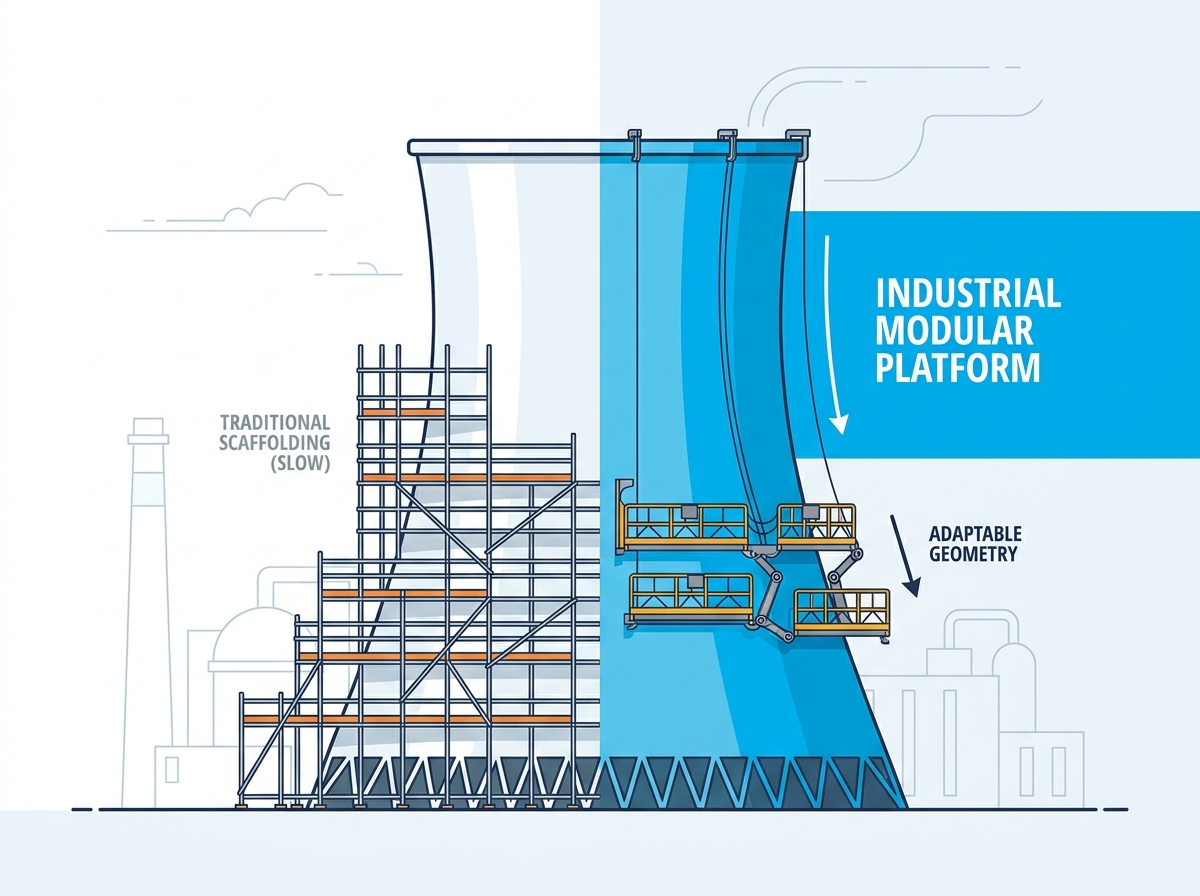
Power plants have historically relied on traditional tubular scaffolding. Crews spend countless hours building these structures inside boilers or along exterior cooling towers. This baseline approach presents massive labor costs. It extends erection times significantly. Scaffolding also creates a massive ground-level footprint obstruction. Facility managers lose valuable floor space. Other maintenance teams cannot access the area until crews dismantle the scaffold. This sequential workflow destroys outage schedules.
You must evaluate access equipment as a pure schedule-compression tool. Top-down access flips the traditional model. A suspended system deploys rapidly from the roof or upper structural members. This approach reduces equipment staging time dramatically. It frees up ground-level space instantly. Your teams can perform concurrent maintenance tasks. Welders can repair upper boiler tubes while mechanics service bottom-ash hoppers below. This efficiency metric directly translates to shorter outages and faster plant restarts.
Transitioning away from scaffolding also shifts your risk and liability profile. Think about the total man-hours spent erecting scaffold tubes. Every hour spent climbing and clamping introduces fall risks. Operating a pre-engineered, certified platform minimizes this exposure. Crews step into a secure, enclosed workspace. They rely on automated hoists rather than manual climbing. This transition protects your workforce. It aligns your site with stringent industrial safety mandates.
Industrial energy facilities present extreme geometric challenges. You cannot easily deploy standard commercial equipment here. A standard High Rise Building Platform works perfectly for flat, predictable glass facades. It fails when confronted with the bespoke needs of a power plant. Facilities feature curved cooling tower surfaces. They contain incredibly confined boiler spaces. Chimneys reach extreme heights. You need specialized configurations to navigate these topographies safely.
The industry relies heavily on standardized heavy-duty lifting series. The ZLP Suspended Platform family serves as the industrial baseline. Models like the ZLP630 and ZLP800 dominate plant maintenance. We must understand their load capacity differences. The ZLP630 typically handles 630 kg. It suits standard inspection crews and light tools. The ZLP800 carries up to 800 kg. You need this higher capacity for heavy maintenance. It easily supports multiple crew members, heavy welding rigs, and abrasive blasting equipment.
Confined spaces demand extreme modularity. You often face narrow boiler manholes. Standard rigid platforms simply will not fit. This makes an Industrial Modular Suspended Platform an absolute necessity. Manufacturers use modular pinning systems to solve this problem. Engineers can break the platform down into smaller sections. They pass these sections through narrow access points. Once inside, crews reconfigure the platform lengths. They adjust sections from 2 meters up to 8 meters. They can also create angled configurations. This adaptability allows the platform to perfectly match the internal contours of vertical vessels or complex boiler walls.
Procurement teams must evaluate access equipment across strict technical dimensions. Material selection forms the first critical choice. You must balance weight against durability. Galvanized steel platforms dominate high-impact zones. You should specify steel for heavy ash environments. It survives abrasive contact and rough handling. Conversely, you should choose an Aluminum Suspended Platform for corrosive zones. Aluminum offers exceptional corrosion resistance. It performs flawlessly near cooling tower mist. It survives flue gas desulfurization (FGD) scrubber environments. It also simplifies lightweight rigging requirements.
The following chart illustrates a basic performance comparison for material selection:
| Material Type | Corrosion Resistance | Impact Tolerance | Rigging Weight | Best Use Case |
|---|---|---|---|---|
| Galvanized Steel | Moderate | Very High | Heavy | Coal boilers, heavy ash areas, dry chimneys. |
| Aluminum Alloy | Very High | Moderate | Lightweight | Cooling towers, FGD scrubbers, damp locations. |
Hoist and motor reliability determines your operational uptime. Traction hoists must meet severe industrial specifications. Power plant environments destroy commercial-grade motors. Airborne particulates penetrate standard casings. You must demand sealed motors. They must be entirely dust-proof. They require heavy moisture resistance. Biomass and coal plants generate highly abrasive dust. Your motors must survive these harsh atmospheric conditions without failing mid-operation.
Safety redundancy remains non-negotiable. Modern platforms must incorporate multiple fail-safes. Do not compromise on these requirements.
Rigging presents distinct engineering difficulties on power plant structures. Standard suspension jibs rarely work on a chimney crown. Roof-level rigging requires custom engineering. Site teams must often design alternative suspension points. They frequently utilize specialized parapet clamps. They design custom-engineered steel tie-backs. Engineers tailor these solutions specifically to curved chimney crowns or sloping cooling tower edges. You must ensure structural engineers validate all suspension points before deployment.
Environmental hazards constantly threaten high-altitude operations. Coastal power plants face brutal wind loads. High altitudes amplify these wind speeds. Strict operational limits must govern every lift. You must install sway-control wire ropes to stabilize the platform. These guide ropes prevent the platform from swinging into the concrete structure. Explosive environments require further modifications. Gas plants or coal dust zones often necessitate anti-static platform modifications. Spark-proof rollers and grounded wire ropes prevent catastrophic ignitions.
Regulatory alignment dictates your deployment readiness. Never allow uncertified equipment on an energy site. You must request comprehensive documentation from all manufacturers upfront. This proactive step prevents compliance shutdowns.
Vetting suppliers requires a rigorous checklist. You must evaluate capabilities far beyond the initial equipment specifications. Industrial energy sector deployments demand specialized vendor expertise. You need a partner, not just a parts supplier. Evaluate their global support footprint first. When a hoist fails during a midnight outage shift, you need immediate solutions. Assess their replacement parts availability. A vendor with local warehousing prevents days of idle downtime.
Analyze the vendor’s operational history. Have they successfully deployed equipment in highly corrosive scrubber environments? Do they understand the specific rigging constraints of hyperbolic cooling towers? Vendors lacking power plant experience will struggle with your compliance documentation. They will fail to anticipate extreme environmental hazards. Prioritize vendors who supply dedicated site engineers. These experts guide your initial rigging setup. They train your local crews on daily inspection protocols. They ensure your deployment launches smoothly and safely.
Focus entirely on technical support and lifecycle safety. Require mandatory recertification intervals for all safety locks. Establish strict wire rope replacement schedules before signing any contracts. Ensure the vendor offers comprehensive motor servicing programs. These technical guarantees keep your access platforms compliant and your workforce secure throughout the entire project timeline.
Access equipment acts as a primary driver of project timeline efficiency. It never serves as merely a secondary accessory. Outdated scaffolding methods drain your budget and extend your outages. Embracing a top-down, modular access strategy directly accelerates your maintenance programs. Facility managers regain floor space. Crews perform concurrent tasks safely.
Procurement teams must take immediate, proactive steps. Do not simply ask vendors for generic product catalogs. Initiate conversations by providing exact dimensional drawings of your target structures. Supply them with localized environmental data, including wind loads and corrosive exposures. Demand engineered solutions tailored to your boiler manholes and cooling tower curves. By standardizing your evaluation framework, you secure the most reliable vertical access for your facility.
A: Not usually without modification. Boiler access requires platforms that can fit through narrow manholes. This often requires modular knockdown designs. Crews must assemble them inside. The platform must also navigate complex internal tube geometries. Standard rigid commercial platforms simply cannot adapt to these confined, irregular spaces.
A: Aluminum offers superior resistance to ambient moisture and certain chemical exposures, like cooling tower mist. However, operating temperature limits apply. Specific chemical interactions, such as highly alkaline environments, can damage aluminum. You must always clear specific environmental conditions and chemical exposures with the platform manufacturer before deployment.
A: They typically require 3-phase 380V, 415V, or 440V power, depending on your region. You need secure, heavy-duty industrial cabling to power the hoists. Crucially, electrical engineers must perform voltage drop calculations for extreme vertical drops, such as 200m+ chimneys, to ensure consistent motor performance.


