 注: 建议图片大小150px*50px
丨
English
注: 建议图片大小150px*50px 


Views: 0 Author: Site Editor Publish Time: 2026-06-13 Origin: Site


Operating offshore wind farms presents immense engineering challenges. The Guohua Shanwei site exemplifies this brutal environment. Technicians face harsh marine conditions daily. They endure immense wind loads and relentless saline-alkali corrosion risks. Maintenance remains a primary bottleneck for these massive structures. Tasks involving blades and towers dictate offshore operational expenditure. They ultimately determine overall energy yield. Prolonged downtime directly impacts profitability and grid reliability. We cannot rely on basic access methods. You need highly specialized access equipment. This article provides an evidence-based breakdown of targeted access strategies. We show how customized solutions address specific structural challenges at Guohua Shanwei. It serves as an evaluation blueprint. Procurement and safety engineering teams can use this guide to implement reliable deployment tactics.
The Guohua Shanwei offshore site operates under extreme atmospheric demands. Technicians deploy equipment into a Category 4-5 corrosive marine environment. Airborne salt density accelerates metallic degradation rapidly. We see standard steel structures fail here within months. Unpredictable wind gusts further complicate daily operations. Gusts routinely exceed safe operational thresholds without warning.
Structural complexities add another layer of difficulty. Offshore wind towers feature a distinct tapered design. They grow significantly narrower toward the nacelle. Modern composite blades exhibit dramatic aerodynamic sweep. This curvature maximizes energy capture but frustrates maintenance access. Technicians cannot simply descend a straight vertical line.
Downtime carries a massive financial penalty. Every delayed hour halts power generation. Lost megawatt-hours directly impact revenue streams. Inadequate access equipment creates maintenance bottlenecks. You cannot afford to wait days to deploy slow, rigid scaffolding. Rapid, safe access directly protects energy yield.
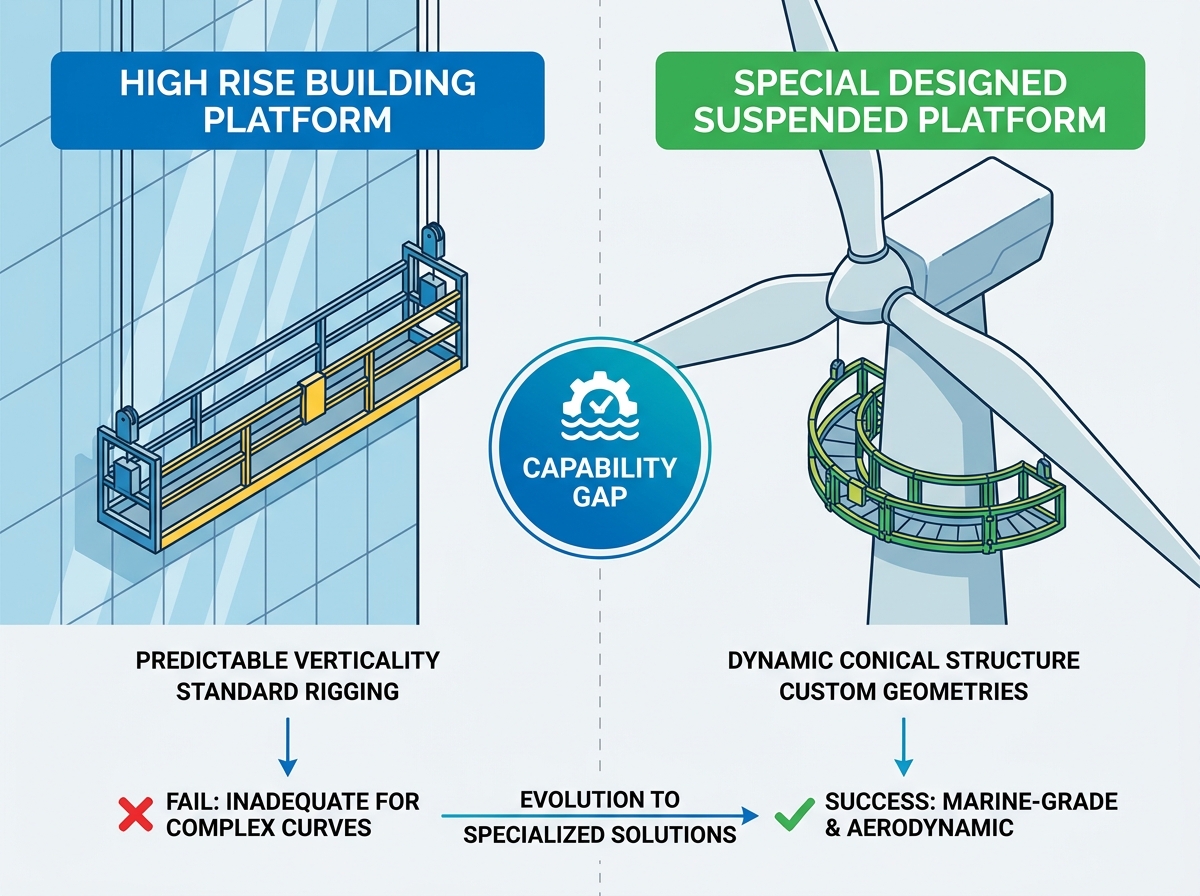
Commercial real estate offers predictable verticality. Standard building facades drop straight down. They provide flat surfaces for equipment stability. Wind turbines present a radically different geometry. They feature dynamic, conical structures. A High Rise Building Platform relies entirely on flat walls. You cannot safely deploy it against a curving turbine tower.
Rigging limitations present severe risks. Traditional setups utilize parapet clamps. Commercial buildings feature roof parapets specifically designed for these clamps. Turbine nacelles lack parapets entirely. They feature rounded composite covers and complex structural frames. You cannot safely adapt commercial parapet clamps for nacelles or tower flanges. Forcing incompatible rigging compromises suspension integrity.
Stability deficits make standard solutions unusable offshore. Standard commercial platforms require continuous surface contact. They use soft rollers to brace against glass or concrete. Wind turbine towers taper inward. A standard platform loses contact halfway down. This lack of contact leads to unacceptable sway. High offshore winds amplify this yaw motion. Technicians face extreme danger inside a swinging platform.
| Feature | Standard Commercial Platform | Offshore Wind Platform |
|---|---|---|
| Target Geometry | Flat, vertical surfaces | Conical towers, swept blades |
| Rigging System | Parapet clamps, roof jibs | Nacelle hardpoints, custom slinging |
| Stability Method | Wall rollers | Soft-touch blade guides, tensioned wires |
| Corrosion Resistance | Standard painted steel | Hot-dip galvanized, aerospace aluminum |
Engineers must adapt access tools to the turbine. Blades require full 360-degree access for thorough inspections. A Special Designed Suspended Platform wraps around the structure. Manufacturers often configure these in U-shape, O-shape, or C-shape arrays. This configuration hugs the blade geometry closely. Technicians reach leading and trailing edges simultaneously. It prevents accidental damage to fragile composite surfaces.
Navigating structural transitions requires mechanical flexibility. Nacelle-to-tower transitions feature abrupt diameter changes. Blade roots vary significantly from the blade tips. A rigid platform cannot navigate these shifts safely. We deploy a Adjustable Angle Corner Platform to solve this. It articulates mechanically. The platform adjusts its footprint to fit varying curvatures. Technicians maintain safe working distances regardless of elevation.
We face a brutal battle against marine corrosion. Standard painted steel fails rapidly offshore. Salt spray induces pitting and structural weakening. We mandate hot-dip galvanized steel or aerospace-grade aluminum alloys. These materials resist aggressive galvanic corrosion. They ensure structural integrity over a 20-year operational lifespan. Aluminum also reduces overall payload weight significantly.
Component sealing dictates electrical reliability. Hoists and control panels contain sensitive electronics. Ingress of salt spray causes immediate short circuits. All critical components demand strict IP-rated protections. We require minimum IP65 sealing for control boxes. Electrical connections must feature marine-grade waterproof glands. This prevents catastrophic operational failures during high-humidity deployments.
Logistics dictate offshore success. Transport vessels offer limited deck space. Cranes operate under strict weight limits. An Industrial Modular Suspended Platform resolves these logistical headaches. It breaks down into standardized, manageable components. Crew members easily load it onto crew transfer vessels (CTVs). Modularity guarantees efficient vessel transport and easier hoisting to the transition piece.
Rapid assembly maximizes productive time. Offshore weather windows close swiftly. Technicians cannot spend hours building scaffolds. We evaluate systems based on connection methodology. Pin-and-lock systems offer superior deployment speed. Bolted joints require torque wrenches and excessive time. Quick-connect pins allow crews to assemble systems quickly before weather deteriorates.
Working at height offshore leaves zero room for error. Redundancy protocols serve as our primary defense. Regulations mandate entirely independent safety wire ropes. We demand overspeed centrifugal brakes on all hoists. If a primary lifting wire snaps, the centrifugal brake engages instantly. It stops a freefall within centimeters.
Dynamic load management prevents hoist burnout. Technicians carry heavy specialized repair materials offshore. Resins, epoxies, and power tools add unpredictable weight. Fluctuating wind pressures push against the platform constantly. Systems require calibrated overload protection. Sensors monitor dynamic weight continuously. They cut power instantly if the payload exceeds safe limits.
We rely on a strict compliance framework. Manufacturer marketing claims hold no value offshore. Shortlisting logic depends entirely on independent certifications. We look for CE marking, strict EN1808 adherence, and ISO 9001 manufacturing standards. These certifications prove the system survived rigorous destructive testing.
| Certification Standard | Relevance to Offshore Operations | Verification Requirement |
|---|---|---|
| EN1808 | Governs safety requirements for suspended access equipment. | Must provide third-party test reports for anti-tilt mechanisms. |
| CE Directive | Ensures compliance with European machinery safety laws. | Requires visible CE marking and declaration of conformity. |
| ISO 9227 | Validates resistance to salt spray environments. | Minimum 1000-hour salt spray test certification for critical parts. |
Scheduling determines deployment success. Site managers track wind speeds meticulously. You cannot deploy equipment during high wave heights. A sudden squall introduces extreme danger. Managers plan operations around strict meteorological limits. We routinely suspend access if wind speeds threaten the aerodynamic stability of the setup.
Rigging introduces massive implementation risks. Securing wire ropes inside a cramped nacelle proves difficult. Technicians must navigate spinning shafts and hot hydraulics. Anchoring requires certified hardpoints. We must also manage heavy umbilical power cables. High winds catch these cables easily. Unsecured cables drag the platform off balance. Crews use tensioned guiding wires to control umbilical movement.
Human error remains our highest risk factor. Specialized access equipment demands elite training. Only certified technicians handle these deployments. We mandate GWO (Global Wind Organisation) certifications. Crews complete rigorous Working at Heights and Sea Survival modules. Competency ensures safe rescues if a hoist fails mid-operation.
Deploying the correct access framework transforms offshore maintenance. It directly reduces costly downtime at complex sites like Guohua Shanwei. Proper engineering ensures strict safety compliance. A robust Suspended Platform tailored for blades and towers eliminates the risks of improvising with standard building tools. It protects both human lives and mechanical assets.
Procurement and engineering teams must act strategically. Follow these critical next steps to evaluate vendors:
A: Industry standards typically cap operational wind speeds at 12 to 14 meters per second. This limit depends heavily on local safety regulations and specific platform certifications. You must always consult the manufacturer load charts. Exceeding these limits induces dangerous yaw motions and stresses the rigging beyond tested safety factors.
A: It attaches using specialized nacelle rigging systems. Technicians utilize built-in structural hardpoints designed by the turbine manufacturer. In some cases, we deploy temporary suspension jibs mounted securely inside the nacelle housing. Strong wire ropes drop through designated floor hatches to lift the platform below.
A: Yes, but it requires strict compatibility checks. You cannot blindly mix components. Engineering sign-off is absolutely mandatory. Modifications alter the center of gravity. Technicians must ensure load balance remains stable. They must verify anti-tilt safety lock alignment stays uncompromised during angular adjustments.
A: Offshore equipment requires rigorous maintenance. Crews must perform comprehensive freshwater washes immediately post-deployment. This removes corrosive salt deposits. Maintenance schedules demand regular Non-Destructive Testing (NDT) on load-bearing welds. We also enforce strict wire rope inspection protocols to detect hidden galvanic corrosion or broken strands.


