 注: 建议图片大小150px*50px
丨
English
注: 建议图片大小150px*50px 


Views: 0 Author: Site Editor Publish Time: 2026-06-13 Origin: Site


High-rise construction and exterior facade maintenance present strict logistical and safety constraints. Traditional ground-supported scaffolding quickly becomes structurally and economically unviable for towering modern skyscrapers. You need reliable vertical access solutions capable of navigating extreme heights safely and efficiently. Selecting the correct suspended access system requires balancing heavy payload requirements, complex building geometry, wind load restrictions, and stringent regulatory compliance like OSHA or EN1808 standards. This evaluation framework equips project managers, structural engineers, and procurement teams with essential technical criteria. You will learn how to specify, compare, and successfully implement suspended access solutions for your high-rise projects. We will cover equipment variations, safety standards, and practical rigging realities so you can elevate your team confidently. Understand the critical differences between material configurations and alternative access models. Master the operational realities governing these critical elevation systems today.
Modern construction demands rapid vertical access. Ground-supported scaffolds fail to meet these demands on supertall structures. You need a reliable solution designed for extreme elevations. A High Rise Building Platform serves this precise operational role. It facilitates daily facade maintenance, curtain wall installation, and structural repairs. You deploy these systems to keep workers safe during complex exterior tasks. They also provide stable platforms for glazing replacement and exterior painting.
Project managers define success through continuous worker access. You cannot compromise the structural integrity of the roof or parapet during daily operations. Predictable setup and dismantling timelines matter immensely. Project delays cascade quickly on large job sites. You must stick to rigid installation schedules. Successful deployment means your crew moves vertically without causing structural damage to the host building.
Assess the commercial impact carefully. Building traditional scaffolding takes weeks. It consumes massive labor hours and blocks pedestrian walkways below. Alternatively, hoisting a modular system takes mere days. Rapid vertical mobility accelerates the entire critical path. You save labor hours and accelerate project handovers. We evaluate these outcomes by comparing daily labor output against equipment rental durations. Fast vertical access translates directly into faster project completion.
Evaluating material choices dictates your entire rigging strategy. An Industrial Modular Suspended Platform offers immense configuration flexibility. You can connect sections ranging from 1m to 3m in length. This modularity adapts easily to complex architectural facades. You build the exact length required for specific building profiles.
Let us compare the two dominant structural materials used today.
Steel provides high resistance to impact damage. It requires a lower initial capital outlay. Many contractors prefer steel for rough environments. However, it carries significant disadvantages. Steel generates a much heavier dead load. You must add substantial counterweights to your roof structure. Furthermore, poorly galvanized steel corrodes quickly in harsh weather. Heavy steel components also slow down manual assembly processes on the roof.
Transitioning to an Aluminum Suspended Platform introduces key operational advantages. Aluminum delivers an excellent strength-to-weight ratio. It resists corrosion naturally. Assembly crews handle lightweight aluminum sections much easier. Lighter decks reduce stress on complex roof rigging systems. You need fewer counterweights. The primary drawback involves upfront procurement costs. Aluminum systems also require specialized welding during major structural repairs.
Match the platform material to your specific site environment. Specify aluminum for weight-restricted roofs and corrosive coastal zones. Choose steel for heavy-duty masonry jobs or high-debris environments. You must weigh the initial purchase price against daily operational efficiency.
| Evaluation Dimension | Steel Configuration | Aluminum Configuration |
|---|---|---|
| Dead Weight | High (Requires more counterweights) | Low (Reduces roof load stress) |
| Corrosion Resistance | Moderate (Depends on galvanization) | Excellent (Ideal for coastal climates) |
| Impact Durability | Excellent (Handles heavy masonry well) | Moderate (Prone to denting under heavy impact) |
| Manual Handling | Labor-intensive assembly | Rapid, ergonomic assembly |
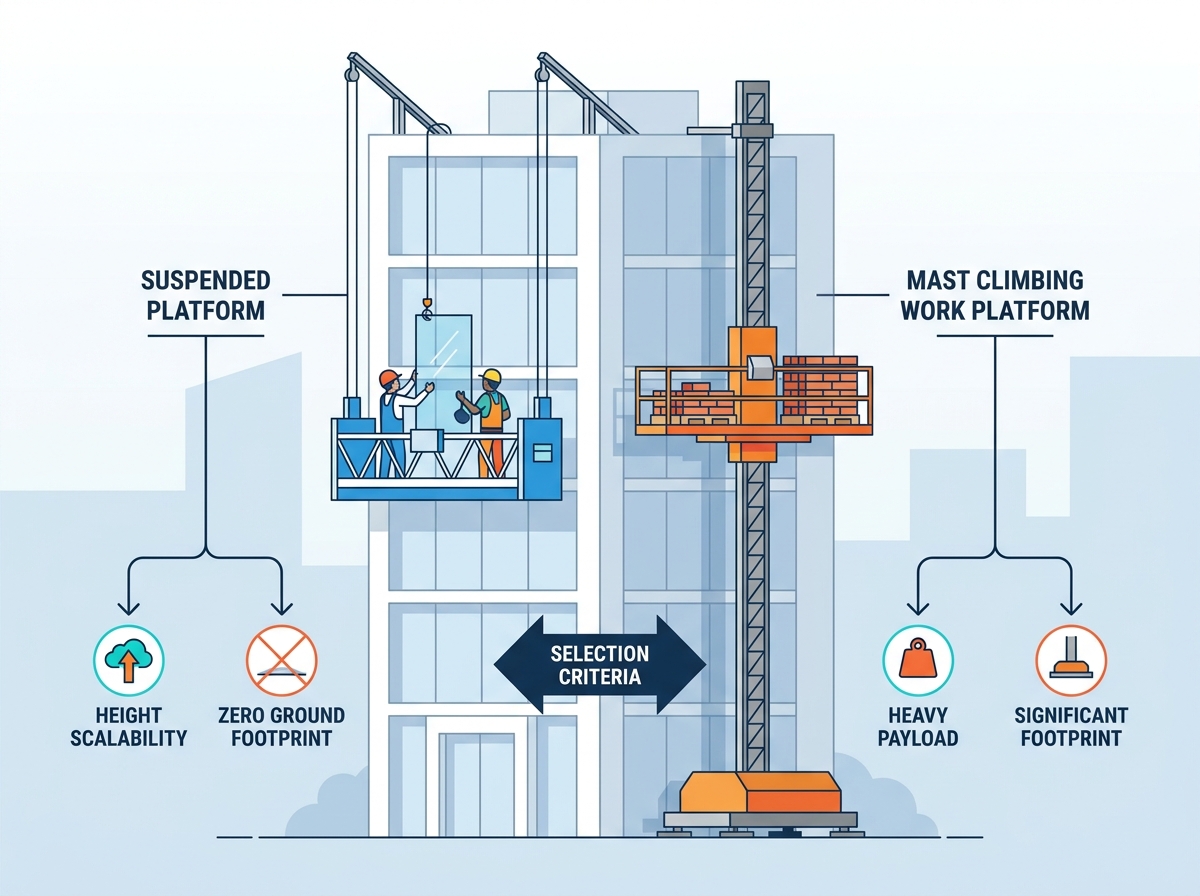
You must evaluate alternative access methods objectively. Sometimes a Suspended Platform is not the optimal choice for specific tasks. Project teams frequently compare them against mast climbing solutions. Both systems elevate workers, but they serve entirely different logistical profiles.
Congested urban sites lack free ground space. Suspended systems require zero ground footprint. They hang entirely from the roof structure above. This keeps pedestrian zones clear. Conversely, a Mast Climbing Work Platform demands a large ground bearing surface. You must prepare a reinforced concrete foundation. Ground logistics often dictate the final equipment choice before work begins.
Building height dictates equipment viability. Suspended systems rely on wire ropes. They scale easily to supertall structures. You simply spool longer wire ropes. Mast climbers face strict structural constraints. You must tie them into the building facade regularly. Tying in damages the exterior finish. It also slows down the vertical ascent significantly.
Consider your daily payload requirements. Mast climbers offer superior heavy-load capacities. They lift massive pallets of brick or block effortlessly. Their wider decks accommodate bulk materials alongside multiple workers. Suspended systems target lighter, personnel-focused tasks. They excel at glass panel installation, structural inspections, and sealant application.
Implementation demands rigorous engineering oversight. You cannot guess counterweight calculations. Site safety depends entirely on mathematical precision and reliable mechanical components.
Evaluate your suspension mechanisms carefully. Standard outrigger beams work perfectly for flat roofs. Parapet clamps save space but require structurally sound parapet walls. Custom davit arms fit complex architectural geometries. Accurate counterweight ratios remain a mathematical necessity. Industry standards dictate a strict 3:1 safety factor against overturning moments. Never compromise this ratio to save time or effort.
Reliable traction hoists drive vertical movement. The LTD series hoists represent the global industry standard. They operate via an alpha pass rope routing system. These motors require a stable, dedicated three-phase power supply. Voltage drops at extreme heights cause motor failure. You must specify appropriate power cables to minimize electrical resistance. Secondary step-up transformers often solve high-altitude voltage drop issues.
Wind load limits pose the highest operational risk. Sudden gusts destabilize hanging decks quickly. You must implement digital anemometers on the roof. Establish hard stop-work protocols immediately. Suspend operations when wind speeds exceed manufacturer and regulatory thresholds. Most regulations cap safe operation around 14 meters per second.
Wire rope failure leads to catastrophic outcomes. Rope jamming and metal fatigue represent constant threats. Proper tensioning prevents slack accumulation near the hoist mechanism. Riggers must conduct visual inspections daily. They look for broken wires, severe kinks, and bird-caging. Discard damaged ropes immediately upon discovery.
Compliance requires deep knowledge of international regulatory frameworks. Safety is never optional at 50 stories high. You must navigate and strictly enforce these standards.
Project managers must follow OSHA 1926 Subpart L in the United States. International projects follow EN 1808 or GB/T 19155 standards closely. These specific codes ensure your equipment design meets statutory safety margins. They govern everything from material thickness to electrical enclosure ratings.
Modern platforms require overlapping redundancy systems. Mandatory integration of independent safety wire ropes saves lives daily. Overspeed safety locks (typically LSF or LSL series) engage automatically during freefall events. They clamp onto the safety rope instantly. Secondary mechanical braking systems inside the hoist provide additional stopping power during power failures.
Workers must use independent lifelines at all times. Clarify this rule repeatedly during morning toolbox talks. Crew members must tie off to a lifeline anchored securely to the roof structure. They must never anchor their safety harness to the platform itself. If the primary suspension system fails, the independent lifeline catches the falling worker. Ensure rope grabs and lanyards meet current ANSI or EN testing standards.
You must conduct strict load testing on site. Static and dynamic load testing must occur prior to initial use. Repeat these rigorous tests after any structural modification or relocation. Load tests verify hoist lifting performance. They also prove brake reliability under maximum stress. Document all load test results in your daily safety logbook.
Procurement decisions impact project safety directly. Avoid selecting vendors based solely on baseline pricing. Cheap equipment often lacks proper engineering support and critical safety certifications.
Demand proper documentation upfront. Never procure equipment without verified structural calculation sheets. Request valid ISO, CE, or UL certifications. Comprehensive user manuals must accompany every delivery. These documents prove the manufacturer follows standardized quality control processes.
Prioritize suppliers offering robust technical backing. They should provide site-specific rigging plans regularly. Non-standard roof designs require custom engineering. Sloped roofs and fragile parapets demand specialized outrigger configurations. A strong vendor will draft CAD drawings demonstrating exact counterweight placements for your specific building.
Evaluate component lead times carefully. Project downtime costs thousands of dollars daily. Your vendor must stock critical replacement parts locally. Fast access to replacement hoist motors, overspeed safety locks, and galvanized wire ropes keeps your project moving. Ask potential vendors about their average dispatch time for emergency spare parts.
Successfully deploying vertical access equipment requires careful planning and rigorous engineering. The choices you make directly impact worker safety and project timelines. Keep these actionable takeaways in mind for your next high-rise project:
Take immediate action by auditing your current equipment vendor. Request their latest structural calculation reports and assess their spare parts availability. Prepare your site-specific rigging plans early in the architectural design phase to ensure seamless equipment deployment later.
A: Typical load capacities range from 500kg to 1000kg. The total capacity depends heavily on the modular length. Shorter configurations (e.g., 2 meters) often support heavier concentrated loads, while extended configurations (e.g., 8 meters) reduce the allowable per-meter payload to maintain structural deck integrity.
A: Aluminum significantly reduces the platform's dead weight. This lighter deck requires proportionally fewer counterweights on the roof to maintain the mandatory 3:1 safety factor. Consequently, it dramatically lowers the total point-load stress exerted on the building's roof slab and parapet structures.
A: A practical rule of thumb points to mid-to-high rise thresholds, typically around 30 to 40 meters. Beyond this height, the cost and labor required to continually install wall tie-ins for a mast climber become prohibitive. Suspended systems rely simply on longer wire ropes, making them highly efficient for supertall structures.
A: Competent riggers must conduct visual inspections of wire ropes and safety locks daily before every shift. They must check for kinks, broken wires, and proper lock engagement. Additionally, a certified third-party professional must perform a comprehensive recertification and load test annually or bi-annually, depending on local regulations.


