 注: 建议图片大小150px*50px
丨
English
注: 建议图片大小150px*50px 


Views: 0 Author: Site Editor Publish Time: 2026-06-14 Origin: Site


Elevator shaft installation remains one of the most critical phases in high-rise construction. It introduces significant operational risks. It also heavily impacts project timelines. Traditional scaffolding creates major labor bottlenecks. Erecting multiple levels requires massive material handling. It ties up tower cranes unnecessarily. Scaffolding also restricts vertical mobility within the confined shaft. You lose valuable days adjusting working heights manually. Construction managers are increasingly shifting toward scaffoldless methods.
Utilizing a Temporary Suspended Platform accelerates project timelines dramatically. However, this transition introduces new variables. You must oversee strict safety compliance constantly. Load management becomes highly dynamic. Vendor selection requires intense scrutiny. We designed this article to help. Our goal is straightforward. We provide project managers, procurement leads, and site engineers an evidence-based framework. You will learn how to evaluate equipment properly. You will discover how to shortlist suppliers effectively. Ultimately, you will implement a reliable access system without compromising site safety.
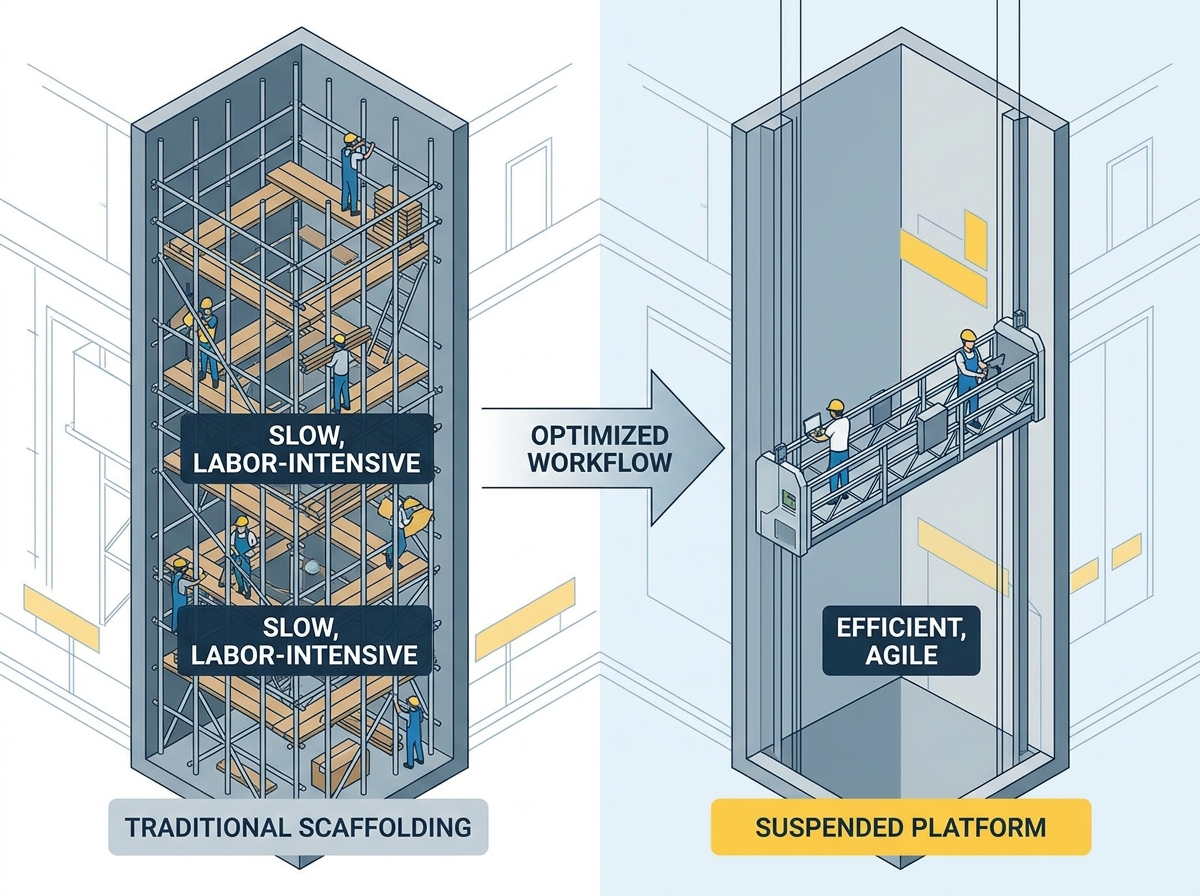
Replacing conventional scaffolding with an elevator installation platform reduces setup time and accelerates vertical workflow.
Evaluating platform modularity and hoist capacity is critical for adapting to varying shaft dimensions and project scopes.
Procurement must prioritize a CE Certified Suspended Platform to ensure compliance with stringent international safety standards (e.g., EN 1808).
Successful implementation requires assessing hidden risks, including top-slab load bearing, cable management, and operator training requirements.
Traditional scaffolding takes days to erect. Dismantling it consumes even more time. These fixed structures eat into your project margins constantly. They actively delay elevator mechanical installations. Scaffold components clutter the shaft floor. You struggle to stage heavy machinery effectively. The industry needs a smarter approach.
The scaffoldless advantage provides a modern solution. An efficient Elevator Installation Platform allows technicians to follow progress vertically. They maintain an ergonomic working height constantly. This reduces physical strain. It boosts installation accuracy. Technicians reach brackets and rails easily. They do not bend or overreach.
Success criteria require specific performance metrics. You want reduced labor hours per shaft. You need lower material transport costs. You also expect an unencumbered shaft floor. This open space allows immediate heavy machinery staging. Consider the ROI carefully. Motorized systems carry a higher initial procurement cost. Equipment rentals also impact upfront budgets. You must balance this against severe reductions in man-hours. Projects finish weeks earlier. You unlock substantial early-completion bonuses.
Evaluation Metric | Traditional Scaffolding | Scaffoldless Access System | Business Impact |
|---|---|---|---|
Setup Time | 5 to 7 days per shaft | 1 to 2 days per shaft | Accelerates critical path schedules. |
Material Handling | Massive (requires crane time) | Minimal (components fit in hoists) | Frees up tower cranes for other tasks. |
Ergonomics | Poor (fixed deck heights) | Excellent (infinite adjustability) | Reduces worker fatigue and injury rates. |
Floor Clearance | Blocked by structural base | Completely clear | Allows parallel heavy machine installation. |
Shaft dimensions vary across different projects. Commercial buildings often use standard wide shafts. Custom residential projects demand unique, tight layouts. When evaluating an Elevator Access Platform, adjustable configurations matter greatly. Assess U-shape designs closely. They wrap around guide rails perfectly. Rectangular layouts suit standard passenger lifts. Custom layouts handle bespoke architectural designs.
Evaluate modular pin-and-bolt systems carefully. These mechanisms allow rapid deck reconfiguration. Technicians can move the equipment between different elevator banks quickly. They do not need specialized welding tools. They simply unpin, adjust, and lock. This modularity saves crucial setup days. It allows you to reuse one physical asset across multiple shaft types.
Determining required payload requires precise calculations. You must factor in multiple weight variables. Calculate the combined weight of personnel first. Usually, two to three technicians work simultaneously. Add the weight of steel guide rails. Include heavy wall brackets. Do not forget heavy installation tooling and hardware.
Traction hoist evaluation demands strict technical scrutiny. Review the wire rope specifications carefully. Hoists must use specialized galvanized steel cables. Lifting speeds determine daily efficiency. Most systems operate at 8 to 9 meters per minute. This speed balances rapid transit and safe positioning. Check continuous operational limits. Hoists must handle extended duty cycles. They run constantly during peak installation days.
Site power dictates equipment selection heavily. Verify voltage requirements early in planning. Heavy-duty hoists often require 3-phase 380V setups. Some regional sites might need customized power setups. You must match the control panel to local grid standards.
Shaft environments pose severe environmental challenges. They are incredibly dusty. Concrete dust infiltrates moving parts. High humidity causes rapid component corrosion. Poor lighting complicates visual safety checks. Component durability ensures continuous operation. Look for IP55-rated electrical enclosures. Demand sealed motor bearings. These protective features survive harsh internal shaft environments.
Procurement policies must prioritize liability mitigation. A CE Certified Suspended Platform is a hard requirement. It proves adherence to rigorous manufacturing standards. It protects your workforce from catastrophic failures. It simplifies site compliance audits greatly.
Always align your equipment choices alongside local occupational safety regulations. Standards like OSHA apply rigidly in North America. The EN 1808 standard governs suspended access equipment globally. CE marks prove adherence to these exact testing frameworks. Authorities demand these certifications before granting operational permits. Never compromise on certified safety baselines.
Failures happen on construction sites. Redundancy saves lives. You must demand specific automated safety mechanisms.
Anti-Tilt Safety Locks: These mechanisms detect hazardous wire rope inclination. They monitor the deck angle constantly. They halt the entire system automatically. Triggers activate when angles exceed safe limits. This limit typically ranges from 3° to 8°.
Overload Protection: Sensors monitor hoist strain continuously. They prevent hoist operation instantly. This lockout happens if the safe working load (SWL) is exceeded. Workers cannot bypass this critical sensor.
Emergency Descent Systems: Unexpected power failures trap workers mid-shaft. Manual release protocols allow safe, controlled lowering. Technicians use a mechanical lever. They glide to the nearest floor landing safely.
Evaluate your structural integrity first. Examine the elevator shaft ceiling. Assess the machine room floor carefully. Concrete must cure fully before bearing any dynamic loads. You must choose an appropriate anchoring method. Building structural realities dictate this choice.
Temporary suspension beams work well for flat roofs. They distribute weight evenly across the slab. Parapet clamps utilize existing reinforced wall strength. Direct-to-slab anchoring offers extreme stability. Engineers must sign off on load-bearing calculations.
Avoid these common mistakes during anchoring:
Ignoring micro-fractures in the top slab before anchor placement.
Using incorrect expansion bolts for high-vibration dynamic loads.
Failing to calculate the shock load during an emergency stop.
Ultra-deep shafts create logistical headaches. Power cables tangle easily. Independent safety ropes snag on protruding brackets. You need clear management strategies. Use dedicated cable guides. Deploy weighted tensioners at the shaft bottom.
Maintain strict minimum distances. The clearance between deck edges and shaft walls is critical. You must avoid collisions during minor platform sway. Roller bumpers help maintain this safe distance. Follow these best practices for cable management:
Install independent anchor points for all secondary safety lifelines.
Utilize heavy-duty counterweights to keep cables taut.
Inspect power cable sheathing daily for friction wear.
Separate power lines from communication lines to prevent interference.
Equipment is only as safe as its operator. Document standard operating procedures (SOPs). Mandate daily pre-use inspection checklists. These simple steps prevent catastrophic oversights. Supervisors must enforce these checklists rigorously.
Operators must receive mandatory training. They need to understand emergency rescue plans completely. Provide practical, hands-on demonstrations. Log all training sessions for compliance audits. Untrained personnel must never operate shaft equipment.
Apply a strict trust check during procurement. Move beyond glossy marketing brochures. Evaluate the vendor's engineering documentation deeply. Assess their post-sale infrastructure. True expertise reveals itself in technical transparency.
Every reliable Suspended Platform needs clear documentation. Require highly detailed installation manuals. Request comprehensive load charts. Require clear electrical schematics. These documents must match the rigor of top-tier elevator brands. Vague manuals signal poor manufacturing quality.
Assess availability and lead times for replacements. Look closely at friction brake pads. Check wire ropes and electrical contactors. Evaluate the manufacturer’s warranty limitations. Factory-level technical support capabilities dictate your operational uptime. You need rapid answers when equipment stalls. Select partners offering dedicated engineering support channels.
Selecting an efficient access solution balances dimensional adaptability, certified safety mechanisms, and robust manufacturer support. We explored the stark differences between scaffolding and modern motorized systems. We detailed crucial evaluation metrics including modularity, hoist capacity, and fail-safe redundancies.
Avoid uncertified, low-cost alternatives completely. The liability risks of equipment failure far outweigh marginal upfront savings. Site safety requires uncompromising standards. Poor equipment choices jeopardize lives and schedules.
Take immediate action today. Audit your current shaft dimensions thoroughly. Define your maximum payload requirements precisely. Request comprehensive technical dossiers from shortlisted, CE-certified suppliers. Implement a safer, faster installation workflow.
A: Standard swing stages hang flat on building exteriors for general façade work. Elevator platforms feature custom sizes for enclosed shafts. They often utilize multi-level decks or U-shapes. These custom shapes surround guide rails perfectly. This design allows technicians to work ergonomically on all shaft sides simultaneously.
A: Deployment usually requires 1 to 2 days. This includes initial setup, anchoring, and mandatory safety testing. In contrast, traditional scaffolding requires weeks to erect in high-rise shafts. Motorized systems provide massive schedule advantages. They allow mechanical installation to begin almost immediately.
A: Built-in traction hoists feature manual descent mechanisms. Technicians use a mechanical release lever to lower the deck safely. Gravity powers this controlled descent. Secondary safety cables and anti-tilt locks remain active during this process. Workers can glide to the nearest floor landing safely.
A: A CE mark represents a globally recognized benchmark for manufacturing quality and safety. However, it does not automatically guarantee regional compliance. Local site engineers must still verify adherence to specific regional occupational safety laws. You must register the equipment according to local municipal codes before operation.


