 注: 建议图片大小150px*50px
丨
English
注: 建议图片大小150px*50px 


Views: 0 Author: Site Editor Publish Time: 2026-06-14 Origin: Site


In nuclear power plant operations, planned outages dictate the critical path. Every hour you spend erecting traditional scaffolding translates directly to lost revenue. This tedious process also increases worker exposure to hazardous environments. Shifting from ground-up scaffolding to specialized access solutions changes the operational game entirely. This approach addresses the unique spatial and regulatory constraints found inside nuclear facilities. You can easily navigate vertical vessels, complex pipe racks, and containment domes safely.
Evaluating the right custom access solution requires careful balance. You must weigh extreme compliance mandates against modular flexibility. Readers will learn how this engineering strategy reduces outage durations and supports vital safety protocols. We will explore key design requirements, material selections, and strict vendor qualification criteria. Implementing these modern access methods ultimately protects your workforce while optimizing plant efficiency.
Nuclear maintenance teams constantly battle the clock. When a reactor goes offline, the critical path timeline strictly governs every task. Deploying equipment efficiently becomes a massive operational priority.
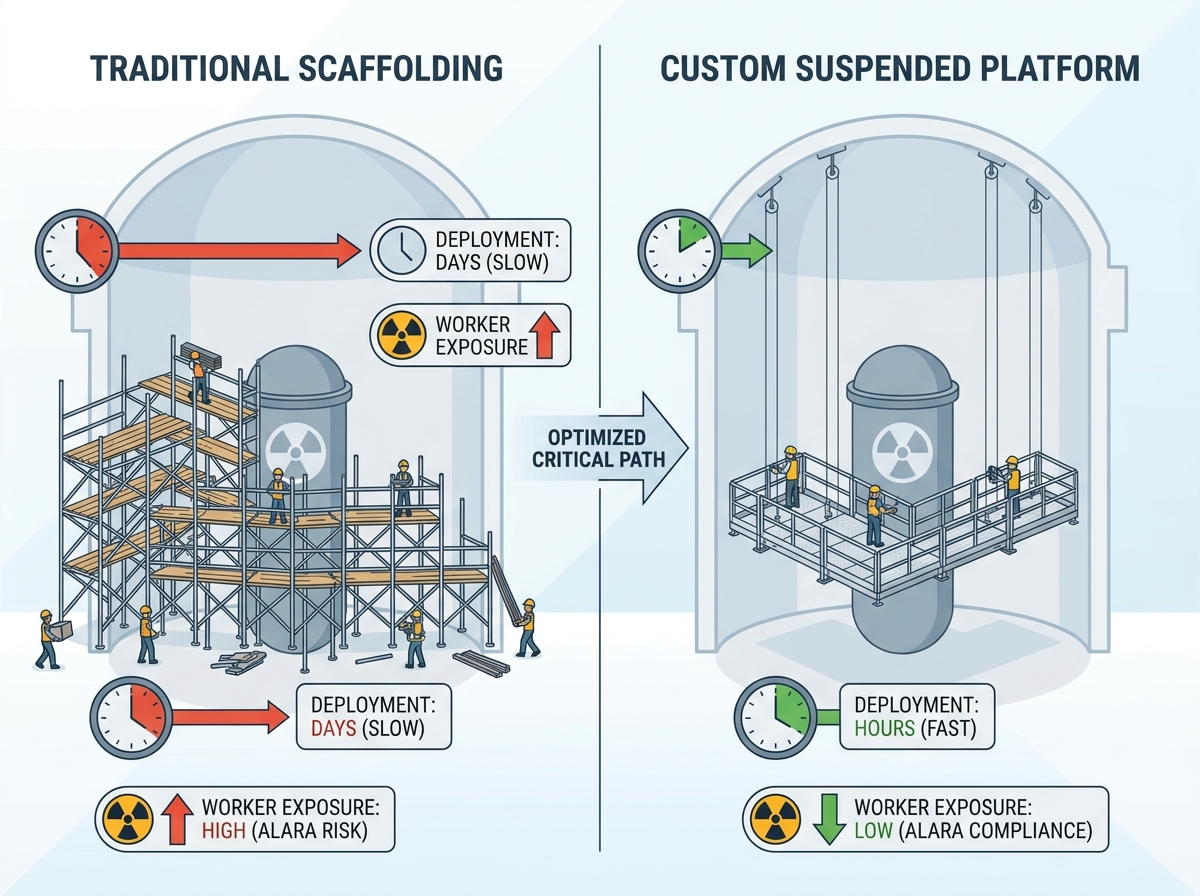
Consider the time-to-deployment metrics. Building a 100-foot scaffolding tower inside a containment building often takes several days. Crews must manually carry hundreds of individual poles, clamps, and boards into restricted zones. Conversely, pre-engineered suspended systems require only hours to deploy. Riggers secure the upper anchor points, lower the hoists, and assemble the main deck. This massive reduction in setup time shrinks the overall outage window.
Furthermore, suspended systems drastically reduce footprint and floor congestion. Traditional scaffolding consumes enormous amounts of floor space. Its bulky base structures block pathways and interfere with concurrent maintenance tasks. By elevating the access equipment, you free up critical ground areas. Welders, inspectors, and material transport vehicles can operate simultaneously below. This spatial freedom mitigates severe bottleneck risks during tightly scheduled outage shifts.
This efficiency aligns perfectly with ALARA (As Low As Reasonably Achievable) principles. Radiation exposure operates on a simple formula: time, distance, and shielding. By minimizing the hours required to build access structures, you directly reduce the cumulative dose exposure for your scaffolders and maintenance crews. Faster deployment means workers spend less time lingering in high-dose zones.
| Criteria | Traditional Scaffolding | Suspended Access Systems |
|---|---|---|
| Deployment Time | Days to weeks for extensive vertical builds. | Hours to a single shift using pre-engineered rigs. |
| Floor Footprint | High. Consumes massive floor space and blocks paths. | Zero to minimal. Completely suspended from above. |
| ALARA Compliance | Poor. Requires prolonged stays in radiation areas. | Excellent. Fast setup limits worker dose exposure. |
| Material Handling | Hundreds of loose components. High drop risk. | Fewer, larger modular sections. Lower drop risk. |
Nuclear environments demand uncompromising safety standards. You cannot simply deploy standard commercial equipment into a reactor building. Every component must pass rigorous evaluation before it enters the site.
First, evaluate regulatory and compliance benchmarks. Your equipment must satisfy OSHA and ANSI standards as a baseline. However, nuclear facilities also impose site-specific safety directives governed by the NRC (Nuclear Regulatory Commission) or local equivalents. Engineering teams must review load calculations, structural integrity, and material certifications. They demand absolute proof that the equipment will not fail under load.
Redundancy and failsafes form the core of nuclear-grade design. Standard equipment might feature basic safety locks. In high-risk nuclear zones, you need secondary independent braking systems. You also require digital overload sensors that prevent hoists from lifting if they snag on an obstruction. Wire rope integrity gets heavily scrutinized. Riggers often specify higher safety factors for cables used above sensitive reactor components.
This brings up an important commercial contrast. A standard commercial High Rise Building Platform is fundamentally inadequate for nuclear environments. While perfectly safe for painting city skyscrapers, commercial models lack the specialized fail-safe redundancy required inside a plant. They usually lack advanced load-sensing technology. They also use standard fasteners that pose unacceptable drop risks in foreign material exclusion zones.
Finally, assess seismic and environmental qualifications. Nuclear facilities undergo strict seismic modeling. Access equipment must withstand site-specific environmental stressors, including unexpected tremors. If a seismic event triggers an emergency protocol, the suspended equipment must remain securely anchored. It cannot swing wildly or drop debris onto critical cooling infrastructure.
Nuclear plants feature incredibly complex internal geometries. Workers navigate around massive vertical vessels, winding pipe racks, and curved containment walls. Standard rectangular platforms rarely fit these spaces.
Accessing vertical vessels and complex pipe racks presents unique rigging challenges. Ground-up scaffolding struggles here because pipes block the floor space below. You must rely on custom-engineered rigging points. Riggers attach specialized clamps to structural I-beams far above the work zone. They safely bypass critical piping without requiring any ground support. This method lets workers access confined vessel walls directly.
Modular configurations offer massive advantages. An Industrial Modular Suspended Platform allows maintenance teams to reconfigure their access tools for different outage tasks. During week one, crews might assemble a long, straight deck for turbine maintenance. During week two, they break down those interchangeable components. They reassemble them into a smaller, specialized shape for reactor cavity access. Standardized pins and interlocking frames make this transition seamless.
Adapting to curves and corners is crucial inside cylindrical containment buildings. Straight edges leave dangerous gaps between the deck and a curved wall. Workers could drop tools or trip through these voids. To eliminate this risk, engineering teams deploy an Adjustable Angle Corner Platform. This custom hinge system seamlessly wraps around cylindrical vessels and cooling towers. It keeps the working edge flush against the curved surface, maximizing worker safety and reach.
Material choices dictate how well access equipment performs inside contaminated zones. You must select metals and surface treatments carefully.
Decontamination compatibility remains a top priority. When equipment enters a radiation area, it picks up surface contamination. After the outage, technicians must wash the equipment before storing it. They use aggressive chemical washdowns and high-pressure steam. Standard painted steel peels and rusts under this abuse. Nuclear-grade equipment uses specialized surface treatments. Engineers often specify anodized finishes or highly durable marine-grade coatings. These surfaces resist radioactive particle adhesion and withstand harsh chemical scrubbers.
You also must balance material weight against durability. In secondary buildings like cooling towers or turbine halls, manual handling becomes a primary concern. Heavy steel components exhaust workers quickly. In these specific zones, an Aluminum Suspended Platform offers incredible deployment advantages. Aluminum provides exceptional strength-to-weight ratios. Workers can carry the modular sections up narrow stairwells without risking severe ergonomic injuries. However, you must restrict aluminum usage in primary containment areas where specific coolants or extreme heat might cause adverse chemical reactions.
Foreign Material Exclusion (FME) protocols heavily influence material and hardware design. A single dropped bolt can destroy a multi-million-dollar turbine or block a reactor cooling channel. FME compliance is mandatory.
To meet strict FME requirements, manufacturers integrate several design features:
Procuring specialized access equipment carries notable implementation risks. You cannot buy this equipment out of a catalog. You must partner with vendors who understand the stakes.
Engineering validation serves as your first line of defense. Never accept generic load charts for nuclear applications. You must require Professional Engineer (PE) stamped drawings. These drawings must reflect the exact site conditions and custom rigging points. The PE stamp guarantees that a qualified structural engineer verified the specific load calculations for your facility's unique geometry.
Next, evaluate the vendor's outage track record. Many companies build excellent general-purpose equipment. However, tight-window nuclear outages require a completely different operational mindset. When shortlisting partners, look for the following criteria:
Finally, assess training and handover capabilities. Supplying the hardware solves only half the problem. The vendor must provide site-specific operational training. Workers need hands-on practice assembling the exact Suspended Platform they will use during the outage. Vendors should also assist in developing detailed rescue protocols. If a power failure leaves a crew stranded halfway up a containment wall, plant safety teams need a validated, rehearsed rescue plan. Ensure your vendor offers rapid technical support throughout the entire outage window.
A custom suspended system represents much more than a simple access tool. It serves as a highly effective critical path optimization strategy. By upgrading from traditional scaffolding to modular, suspended equipment, plant operators drastically reduce deployment times. You actively minimize floor congestion, limit worker radiation dose exposure, and align with strict FME protocols.
To implement this strategy successfully, decision-makers must act early. Do not wait until the outage schedule is finalized. We advise initiating site audits with qualified engineering partners at least 12 to 18 months prior to a scheduled shutdown. This long lead time allows for precise custom design, rigorous compliance approvals, and flawless manufacturing execution. Proper planning ensures your access solutions drive your outage success rather than hinder it.
A: Custom platforms for nuclear use incorporate captive fasteners, integrated toe boards, continuous debris mesh, and specialized tool tie-offs to eliminate drop risks.
A: Yes, an industrial modular suspended platform can be reconfigured using pre-approved, interchangeable sections, provided the new configuration aligns with the PE-stamped load and rigging documentation.
A: Material use depends on the specific plant zone. While an aluminum platform is highly effective for balance-of-plant or cooling tower maintenance due to its low weight, specific areas (like primary containment) may restrict aluminum due to potential chemical reactions under high heat or with certain coolants. Vendors must match materials to the exact operational zone.
A: Due to the required site surveys, structural engineering reviews, PE stamping, and stringent QA/QC manufacturing processes, lead times typically range from 16 to 24 weeks, necessitating early procurement alignment with outage schedules.


