 注: 建议图片大小150px*50px
丨
English
注: 建议图片大小150px*50px 


Views: 0 Author: Site Editor Publish Time: 2026-06-14 Origin: Site


Securing safe vertical access on massive dam infrastructure presents an immense engineering hurdle. You face sheer vertical drops, parabolic concrete curves, and relentless environmental forces daily. Standard commercial construction methods simply cannot handle these extremes safely. Traditional ground-up scaffolding fails completely in this environment. Building scaffolding from a spillway base wastes enormous time. It introduces dangerous structural instability and struggles in water-adjacent zones. These inefficiencies cause unacceptable project delays and significant budget overruns. Moving away from outdated methods is critical for modern infrastructure maintenance. A robust Suspended Platform is the definitive solution for concrete repair, waterproofing, and structural inspections. However, selecting the correct equipment requires deep technical evaluation. In this guide, you will learn how to navigate complex geometric profiles and extreme microclimate stressors. We will explore specialized rigging requirements and strict safety compliance frameworks. Ultimately, this ensures you specify the exact equipment needed for your next dam project.
Dam profiles require highly adaptable, non-standard rigging; off-the-shelf equipment rarely suffices without modification.
Choosing an Industrial Modular Suspended Platform significantly reduces downtime by allowing rapid reconfiguration across different dam sections.
Procurement must prioritize systems with documented compliance (OSHA/international standards), specialized anti-tilt mechanisms, and high-humidity operational resilience.
A successful rollout relies as much on custom crest-rigging solutions as it does on the platform's load capacity.
Dam construction and maintenance demand highly specialized access solutions. Flat architectural facades allow straightforward equipment drops. Dam faces feature parabolic curves, steep inclines, and remarkably deep spillways. You cannot simply drop a standard rig down a curved penstock. The changing geometry forces workers further from the work surface as they descend. Specialized stand-off mechanisms must bridge this gap constantly. Traditional flat-wall equipment leaves gaps compromising worker safety and tool reach.
Environmental stressors complicate operations severely on a daily basis. River valleys generate localized high wind loads constantly. Constant moisture and rapid temperature fluctuations attack equipment integrity relentlessly. We frequently see extreme microclimates forming around intake towers. These microclimates cause sudden wind shears affecting platform stability. Rapid morning temperature drops cause condensation. This condensation affects electrical panels and increases slip hazards on the platform deck.
Crest-level rigging constraints present another severe engineering challenge. Operational dam crests offer incredibly limited footprint space. Active roadways often cross the top of the structure. Securing parapet clamps or massive suspension jibs becomes incredibly difficult here. You must anchor systems securely without disrupting daily dam operations. Space limitations often forbid large counterweight stacks. Engineers must design custom structural tie-backs mapping directly into the existing concrete.
Finally, these projects demand exceptionally high payload requirements. Workers must transport heavy concrete mixes for patching operations. Hydro-demolition gear weighs significantly more than standard window-washing tools. The equipment generates immense reactionary torque during operation. You must also accommodate multiple personnel simultaneously. Standard access gear bends or fails entirely under these intense dynamic loads.
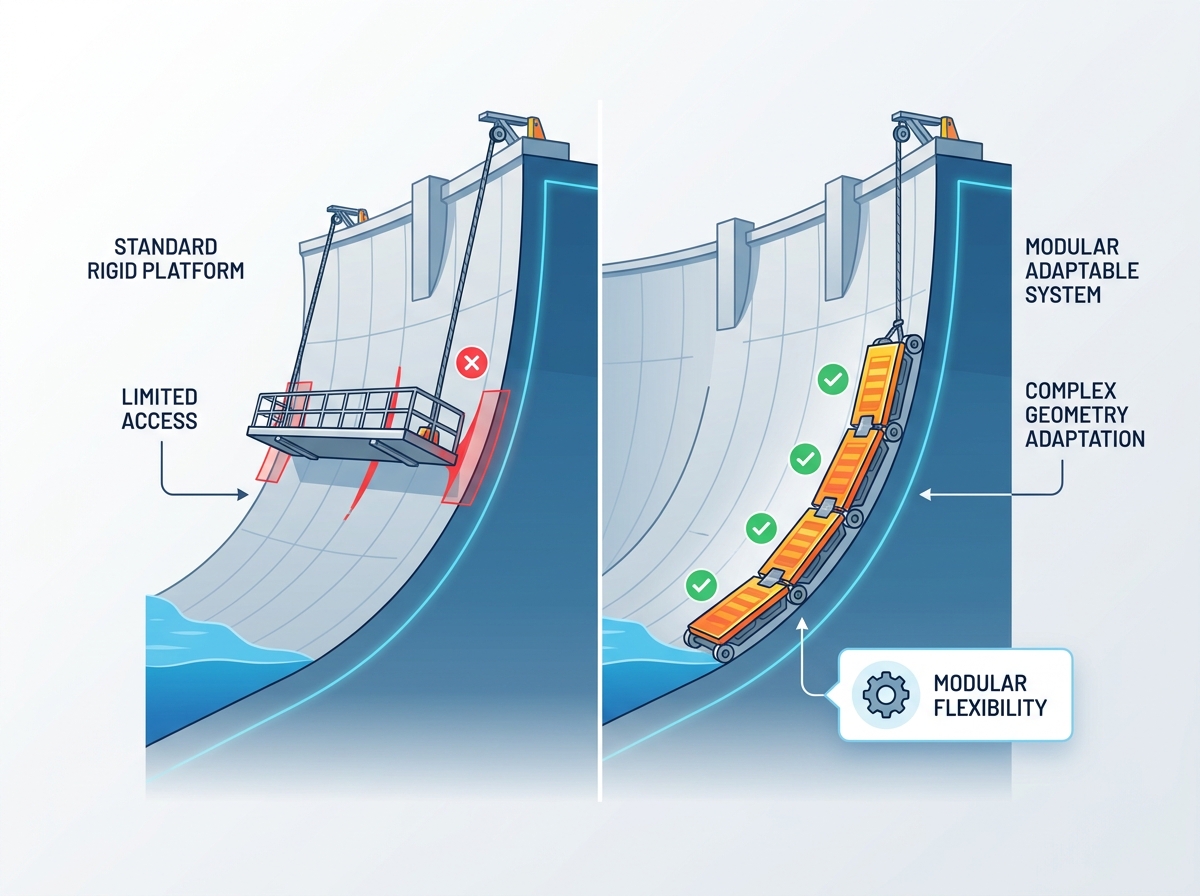
The standard ZLP series offers excellent baseline capabilities for specific vertical zones. Models like the ZLP630 and ZLP800 handle straightforward vertical drops perfectly. You often see them deployed on intake towers or straight vertical pier faces. They provide solid payload-to-weight ratios for general maintenance tasks. Their motor durability stands up to regular daily use effectively. They also feature standardized safety lock integration guaranteeing baseline compliance.
However, you must quickly recognize their structural limitations in complex environments. A standard, off-the-shelf ZLP Suspended Platform struggles significantly on inclined dam faces. It requires heavy engineering modifications before deployment. You will need custom suspension brackets and specialized rollers. These additions maintain platform stability on sharply angled concrete. Without modifications, the center of gravity shifts dangerously.
Flexibility ultimately defines success on varied dam structures. An Industrial Modular Suspended Platform solves complex structural scaling issues directly. Manufacturers design these advanced systems using modular aluminum or steel sections. You can dynamically combine 1-meter to 3-meter segments onsite. This specific scaling matches diverse spillway widths or tight gate dimensions perfectly.
Transportation logistics improve dramatically under a modular framework. Shipping modular components to remote hydroelectric sites offers massive mobilization advantages. Mountain roads rarely accommodate oversized, pre-welded staging. Modular units bypass narrow mountain switchbacks easily. Teams mobilize faster upon arrival. They reconfigure the exact same system for multiple dam zones seamlessly.
Connection styles matter immensely under heavy industrial loads. A Hanging Pin Style Suspended Platform provides distinct structural advantages over traditional bolted frames. The pin connection style enables incredibly rapid assembly onsite. More importantly, it delivers exceptional high load-bearing stability across long spans.
Vibration resistance is a critical operational benefit here. Heavy power tools like large core drills run continuously on the deck. The hanging pin design mitigates joint fatigue effectively during these tasks. Traditional bolted joints loosen over hundreds of hours of intense vibration. The pin system prevents structural loosening during intense hydro-demolition operations.
We must evaluate specific project outcomes before initiating procurement. Environmental context dictates the engineering requirements entirely.
A standard High Rise Building Platform focuses primarily on flat glass or smooth concrete. Designers optimize them for low-weight maintenance tasks. Window washing and light caulking define their operational limits. Dam-grade platforms require completely different underlying engineering. They must support excessively heavy tool payloads safely. They operate continuously in highly abrasive, wet environments. We cannot treat a rugged dam face like a predictable city skyscraper.
Hydroelectric projects feature ultra-long vertical drops rarely seen elsewhere. You must evaluate traction hoists designed specifically for extended descents. Standard commercial hoists overheat rapidly over a 200-meter continuous drop. Furthermore, marine and river environments accelerate steel corrosion aggressively. You must specify heavy-duty, anti-corrosion galvanized wire ropes. Standard carbon steel ropes degrade rapidly near constant spillway mist.
Strict compliance guarantees operational safety and protects liability. You must align equipment specifications to OSHA or EN safety standards. This strict alignment applies to both two-point and multi-point suspended scaffolds. Regulatory frameworks mandate multiple redundant safety systems globally.
Secondary safety wire ropes supporting the entire load independently.
Overspeed safety locks reacting instantly to any slack detection.
Manual descent capabilities guaranteeing safe return during total power failures.
Independent lifeline tie-offs for every individual operator onboard.
Dam topographies are never uniform across different facilities. You must work exclusively with manufacturers offering extensive structural customization. They should provide custom stand-off rollers tailored to your concrete profile. Angled pneumatic bumpers protect both the platform and the dam face. Bespoke suspension mechanisms must adapt to specific dam slopes seamlessly.
Deploying complex access equipment carries inherent operational risks. Anticipating these specific challenges ensures safe, uninterrupted operations. Let us examine four primary adoption risks and their precise engineering mitigations.
Risk 1: Dynamic Wind Loads Unpredictable wind shear dominates most river valleys. Wind channels forcefully through canyons, catching platform decks unexpectedly. This creates dangerous lateral sway. Mitigation: Implement strict wind-speed operational limits utilizing deck-mounted anemometers. Utilize specialized continuous tethering systems connecting to the dam face. Guide-wire setups prevent excessive lateral movement effectively.
Risk 2: Hoist Degradation High humidity and abrasive concrete dust destroy internal machinery. Premature hoist failure halts construction progress immediately. Dust bypasses standard seals easily. Mitigation: Specify fully enclosed, IP-rated traction motors. Enforce strict daily cleaning protocols for all moving parts. Protect the hoists utilizing custom weather covers during off-hours.
Risk 3: Emergency Rescue Complexity Standard commercial rescue protocols fail completely on a 200-meter dam face. You cannot simply lower a ladder from the roof. Fire departments rarely possess reach for these structures. Mitigation: Mandate highly site-specific, pre-rigged rescue plans. Conduct specialized operator training before initial deployment. Equip teams with controlled auto-descent devices enabling self-rescue.
Risk 4: Inadequate Power Supply Massive dam faces require unusually extended electrical cable lengths. This causes dangerous voltage drops reaching the motors. Motors stall or overheat under these conditions. Mitigation: Conduct proper electrical engineering calculations beforehand. Select heavy-gauge cables to maintain steady voltage. Use step-up transformers if necessary to compensate for extreme lengths.
Risk Factor | Impact on Operation | Engineering Mitigation Strategy |
|---|---|---|
Dynamic Wind Loads | Lateral sway, structural stress on rigging | Continuous face tethering, deck anemometers |
Hoist Degradation | Sudden motor failure, prolonged downtime | IP55/IP65 rated enclosures, rigid daily cleaning |
Rescue Complexity | Stranded personnel mid-descent | Pre-rigged rescue systems, self-descent devices |
Voltage Drops | Motor stalling, overheating electrical panels | Heavy-gauge cable selection, step-up transformers |
Selecting the right manufacturing partner outweighs merely finding the lowest price. Dam projects demand rigorous vetting and technical transparency from suppliers.
Buyers must demand detailed, project-specific CAD drawings immediately. Do not accept generic product brochures as proof of capability. You need precise load calculations reflecting your exact dam profile. A reliable supplier proves their math before you sign a contract. They conduct finite element analysis on custom suspension brackets. They show exactly how shear forces transfer to your parapet walls.
Never compromise on verifiable material and operational testing. Require comprehensive factory load testing documentation prior to shipment. Ask for third-party material certifications verifying critical load-bearing components. Verifiable field-case studies in similar hydroelectric projects build necessary trust. They prove the equipment survives real-world river conditions. Documentation must align with your localized regulatory body.
Do not rush the final purchase order. We strongly recommend a comprehensive site audit first. Engage in a collaborative engineering phase directly with the manufacturer's technical team. Share structural blueprints and environmental data openly. This ensures every parapet clamp, wire rope, and hoist matches your site reality perfectly.
Deploying equipment for dam construction represents highly engineered access operations. It is absolutely not a standard scaffolding purchase. Massive heights and harsh microclimates demand absolute engineering precision. You must prioritize equipment modularity to adapt to shifting project phases efficiently. Robust, redundant safety mechanisms protect personnel in unforgiving environments. Manufacturer engineering support dictates both the safety and efficiency of your entire project. Do not settle for basic off-the-shelf solutions when custom configurations remain necessary. Evaluate your specific crest rigging constraints thoroughly before planning. Request technical consultations today. Demand specific load calculations and arrange site-specific rigging assessments to secure your project's operational success.
A: Not without custom stand-off rollers, modified suspension brackets, and strict engineering approval to correctly manage the changed center of gravity.
A: Using custom-engineered parapet clamps, deeply counterweighted suspension jibs, or chemically anchored mounting plates specifically tailored to the dam's crest structure.
A: Setup speed, elimination of a massive ground-bearing footprint, dynamic adaptability to changing water levels, and overall operational efficiency.
A: Localized OSHA regulations regarding multi-point suspension limits, minimum safety factors for anti-corrosion wire ropes, and mandatory independent fall-arrest systems.


