 注: 建议图片大小150px*50px
丨
English
注: 建议图片大小150px*50px 


Views: 0 Author: Site Editor Publish Time: 2026-06-13 Origin: Site


Specifying a permanent facade access system for complex architecture represents a massive operational responsibility. You must balance significant capital expenditure against strict life-safety requirements. Architects and facility managers simply cannot afford errors during this procurement phase. A single failure at extreme altitudes leads to devastating consequences. You must prioritize rigorous engineering over rapid installation schedules.
High-rise window cleaning and facade maintenance demand much more than temporary drop rigs. Modern buildings feature extreme heights, unpredictable wind loads, and intricate glass geometry. They require structurally integrated, compliant systems to keep operators completely secure. Temporary scaffolds lack the stability required for these demanding modern environments.
This guide provides a pragmatic framework for facility managers, building owners, and architects. You will learn how to evaluate, select, and implement the precise equipment for your project. We will help you navigate complex structural realities seamlessly. You will master the process of matching mechanical features directly to your specific operational needs.
Standard access equipment fails frequently on modern skyscrapers. Temporary scaffolding units lack the inherent stability needed at extreme altitudes. Basic drop systems cannot safely navigate complex building geometry. High wind shear turns temporary platforms into dangerous pendulums. You need highly engineered BMU Solutions to overcome these severe environmental challenges. Permanent systems provide rigorous structural integration directly into the building framework. They ensure operators remain entirely secure during sudden high-wind events.
Facade complexities demand highly specialized equipment. Architects often design challenging negative slopes and deep exterior recesses. Delicate glass panels require incredibly careful handling during routine washing. Standard rigs simply cannot reach these recessed architectural areas safely. A customized access system solves this exact outreach problem. Telescopic jibs provide the precise horizontal extension necessary for difficult drops. They extend over challenging architectural features easily and safely.
Operational efficiency matters greatly for facility management teams. You must calculate the required cleaning cycle time carefully. A slow access system increases your labor hours significantly. It forces cleaning crews to waste hours just repositioning the equipment. A dedicated High Rise Building Platform reduces this operational downtime dramatically. Fast, motorized deployment means cleaners wash more windows every single day. You achieve a highly efficient facade maintenance schedule immediately.
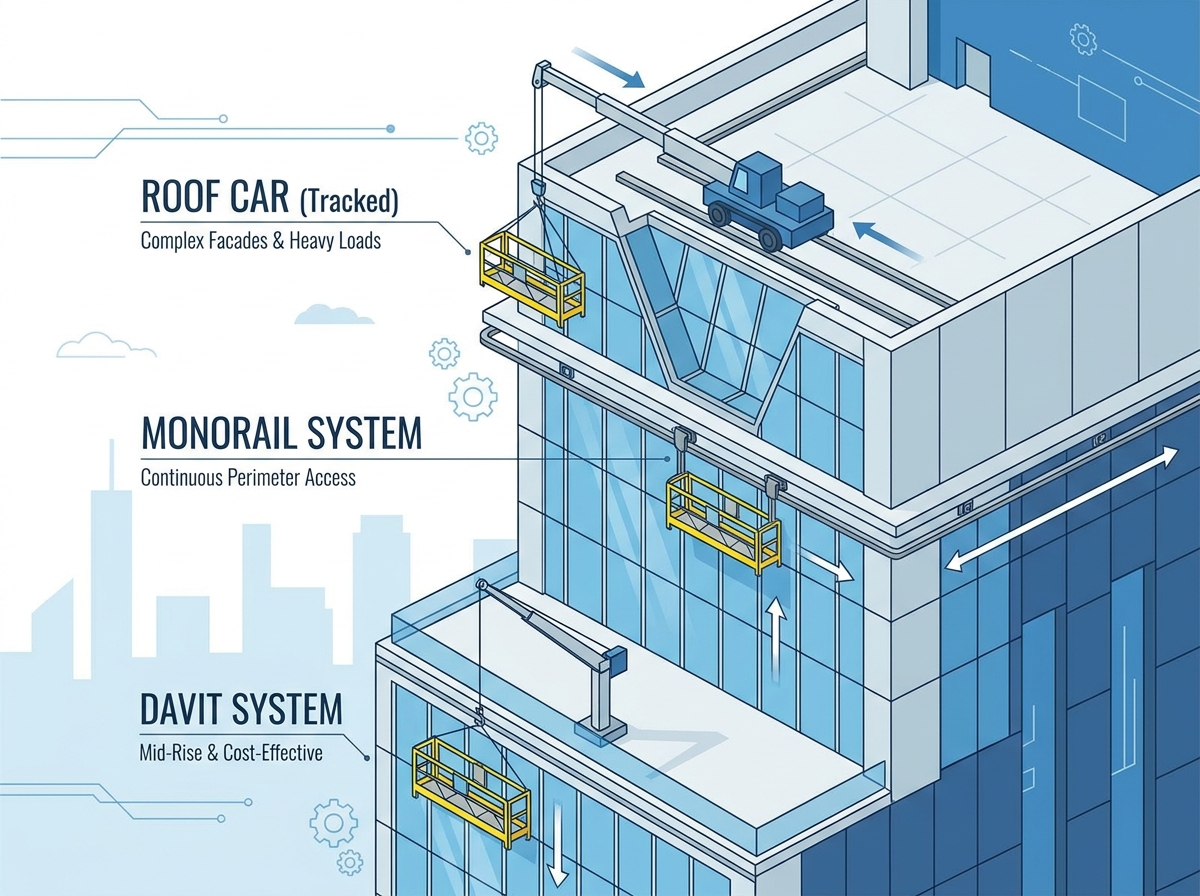
Choosing the correct equipment configuration dictates your ultimate project success. You must evaluate four primary categories carefully.
Roof cars offer maximum flexibility for complex high-rise structures. Tracked roof cars glide smoothly along permanent twin steel rails. Trackless models maneuver independently on reinforced concrete runway pads. Both variations handle extremely heavy load capacities effortlessly. They suit flat, heavily reinforced roofs best. Their telescoping jibs achieve massive horizontal outreach over large penthouses. They utilize luffing cylinders to raise and lower the jib arm safely.
Monorail systems solve entirely different architectural challenges perfectly. They work beautifully for buildings lacking adequate roof space. Engineers mount extruded aluminum tracks along the exterior building perimeter. This configuration allows continuous horizontal movement across the facade. Operators traverse the building envelope seamlessly without raising the cradle. You often see these systems hiding discreetly beneath exterior overhangs.
Davits and socket systems offer an excellent alternative approach. They provide a highly secure Suspended Platform for mid-level structures. You avoid installing permanent, bulky roof cars entirely. Workers simply move portable aluminum davit arms between fixed floor sockets. The sockets are cast directly into the concrete roof deck. This discrete approach suits residential structures under thirty stories perfectly.
Many complex projects require an Industrial Modular Suspended Platform. Manufacturers customize these modular cradles heavily to fit unique building shapes. They build angled corner units for sharp building edges. They adjust overall platform lengths to fit specific mullion spacing. You maintain complete structural integrity while navigating awkward building envelopes safely.
| Configuration Type | Ideal Building Profile | Key Mechanical Advantage | Roof Space Requirement |
|---|---|---|---|
| Tracked Roof Car | Tall skyscrapers exceeding 40 stories | Maximum telescopic outreach and high load capacity | High (requires dedicated track zones) |
| Monorail System | Complex perimeters or sloped roofs | Continuous horizontal movement along the facade | Low (mounted to exterior soffits) |
| Davit System | Mid-rise residential buildings | Minimal visual impact on building aesthetics | Low (requires localized socket points) |
| Modular Cradle | Irregular facades and deep recesses | Adaptable shapes matching building geometry | Variable |
You must align engineering precision directly against structural reality. Facility managers must verify actual roof-bearing capacities before ordering equipment. The proposed machinery must match the building's dead-load metrics perfectly. It must also tolerate dynamic live-load forces during operation. Wind shear creates immense lateral stress on structural anchor bolts. Licensed structural engineers must sign off on these critical calculations.
Mechanical outreach and load capacity dictate daily usability. You must map telescoping jib capabilities carefully against architectural drawings. The slewing ring must rotate the jib to all intended access points. The primary hoist must support operators and heavy payloads safely. Crews often carry heavy tools and replacement glass panels. A robust BMU handles these demanding payloads without stressing the traction motors.
Facade protection mechanisms prevent catastrophic aesthetic damage. Modern curtain walls cost millions of dollars to install. You cannot let swinging steel cages dent expensive mullions. Soft-touch foam rollers protect delicate glass surfaces effectively. Anti-collision ultrasonic sensors halt the cradle automatically upon approaching an obstacle. Automated leveling systems keep the basket perfectly horizontal during descent.
System redundancy saves lives during unexpected equipment failures. You must assess backup manual controls critically. Emergency descent features allow safe return during complete power loss. Redundant braking systems lock the wire ropes instantly upon overspeed detection. We highly recommend evaluating these specific fail-safes during the initial procurement phase.
Navigating regional safety standards forms your absolute regulatory baseline. You must adhere strictly to local engineering rules. OSHA governs high-rise operations rigorously in the United States. EN 1808 dictates European suspended equipment standards comprehensively. Compliance is never an optional upgrade. You must verify it through third-party engineering sign-offs. Independent laboratories test the equipment dynamically before final certification.
You must integrate fall protection holistically across the entire roof. Access systems function strictly within a broader safety ecosystem. They require independent lifelines for every single operator. Secure anchor points must withstand massive shock loads during a fall. Modern harness integrations keep workers securely tethered at all times. Facility managers must train operators thoroughly to use this specialized gear.
Safe Work Method Statements ensure daily operational safety onsite. You need site-specific documentation completed before deploying any system. These documents outline specific hazard controls for your exact building. They dictate strict daily operator protocols and pre-use checklists. They detail emergency rescue plans clearly for the local fire department.
The rollout timeline demands extremely careful project management. You should anticipate multiple distinct procurement phases. Structural feasibility studies often take several weeks to complete. Custom engineering requires detailed architectural coordination between multiple firms. Manufacturing lead times routinely span several months for custom components. Final commissioning involves rigorous on-site load testing using water weights.
Installation risks require proactive and aggressive mitigation strategies. Disruptions happen frequently during heavy crane lifting operations. Craning massive roof cars usually requires temporary street closures below. Retrofitting older buildings presents unique structural challenges. You must reinforce existing concrete roof structures carefully using epoxy anchors. Integrating a system into new construction phases proves much easier. You coordinate installation directly with the primary general contractor.
Lifecycle management guarantees system longevity and strict legal compliance. Rigid inspection schedules prevent catastrophic mechanical failures entirely. Operators must perform daily visual checks before stepping into the cradle. Certified technicians must conduct thorough quarterly lubrication services. Manufacturers require massive structural overhauls at the ten-year mark. A well-maintained Building Maintenance Unit operates safely for decades when serviced properly.
| Inspection Type | Frequency | Performed By | Key Focus Areas |
|---|---|---|---|
| Visual Pre-Check | Daily before use | Trained Operator | Wire ropes, harnesses, emergency stop controls |
| Minor Service | Quarterly | Qualified Technician | Hoist lubrication, sensor calibration, limit switches |
| Statutory Load Testing | Annually | Certified Engineer | Brake performance, anchor point integrity, motor draw |
| Major Overhaul | Every 10 Years | Manufacturer Rep | Hoist rebuild, non-destructive weld testing, rope replacement |
Shortlisting your ideal facade access configuration follows a very clear logic. You must prioritize life-safety compliance strictly above all else. Match the physical system type directly to your specific architectural constraints. Ensure the selected vendor provides highly robust post-installation service. Permanent access equipment requires a lifetime engineering partnership.
Take immediate action to secure your building envelope. We strongly advise initiating a comprehensive site audit today. Consult with licensed structural engineers before moving forward. Map your roof capacity and facade geometry precisely. You can then request technical submittals confidently from leading industry manufacturers.
A: A temporary platform is a modular rig assembled for short-term projects. Workers dismantle it after completing the job. A permanent unit integrates directly into the building structure. It remains onsite continuously for daily operational readiness. Permanent systems meet much stricter regulatory classifications regarding structural stability and wind resistance.
A: Yes, you can retrofit these systems onto existing structures. However, you must conduct a thorough structural feasibility study first. Older roofs often require significant steel reinforcement to handle the heavy machine loads. If roof reinforcement proves impossible, engineers frequently recommend alternative trackless solutions or exterior-mounted monorail systems.
A: Regulatory standards mandate strict compliance intervals for professional servicing. Trained operators must conduct daily visual pre-use checks. Certified technicians must perform minor maintenance and lubrication quarterly. Furthermore, safety regulations require an annual statutory inspection. This includes dynamic load testing and brake certification performed by an independent engineer.
A: Upfront procurement costs depend on several transparent variables. Track length dictates the volume of required steel rails. Telescopic jib reach requires larger counterweights and stronger traction motors. Modular cradle complexity adds engineering hours for custom corner configurations. Finally, necessary roof structural modifications heavily influence the initial project price tag.


