 注: 建议图片大小150px*50px
丨
English
注: 建议图片大小150px*50px 


Views: 0 Author: Site Editor Publish Time: 2026-06-14 Origin: Site


Shipyards and offshore operators constantly battle two competing forces. They face strict operational deadlines alongside rigorous maritime safety requirements. Completing hull maintenance, painting, and vertical inspections on schedule remains vital. However, rushing these tasks over open water or inside active drydocks invites severe hazards. Standard terrestrial scaffolding routinely fails here. It proves highly inefficient and inherently dangerous in demanding marine environments. Tight space constraints limit safe assembly areas. Dynamic water movement destabilizes rigid scaffolding frames. Highly corrosive salt spray rapidly degrades traditional rigging components. We designed this guide to solve these exact access problems. It provides procurement teams, shipyard managers, and EHS officers a reliable, evidence-based framework. You receive transparent criteria for selecting maritime access equipment. You will learn how to evaluate environmental resilience, load stability, and safety compliance. By following these operational guidelines, you drastically reduce vessel turnaround times. Furthermore, you actively protect your crews against unique offshore hazards.
Evaluating a marine suspended platform requires prioritizing specialized corrosion resistance and dynamic load stability over standard terrestrial specifications.
Electric ship platforms offer superior efficiency for high-frequency vertical maintenance but require stricter moisture-proofing and electrical compliance.
Shortlisting vendors must involve verifying maritime-specific EHS compliance (e.g., OSHA marine standards) and reviewing rigorous real-world implementation protocols.
Shipyard bottlenecks often originate from highly inefficient access methods. Crews struggle to reach vertical vessels and external ship hulls safely. Delays in surface preparation or painting quickly cascade into massive scheduling conflicts. Offshore maintenance delays frequently result from scaffolding assembly times stealing valuable daylight hours. Traditional terrestrial equipment simply cannot adapt to these maritime bottlenecks.
Environmental realities further complicate maritime access. Operating near open water exposes equipment to constant salt spray. High humidity levels rapidly attack unprotected steel components. Furthermore, dynamic vessel movement creates significant challenges. Ships shift constantly due to tides, winds, and passing wakes. Rigid access structures cannot absorb this continuous kinetic energy safely. Equipment must flex, stabilize, and endure these harsh forces without compromising structural integrity.
A successful equipment deployment requires measuring specific operational metrics. You evaluate success through drastically reduced setup times. Fast deployment means higher operational efficiency. Safety managers must demand zero compliance breaches during the project lifecycle. The access equipment must also demonstrate minimal degradation over a rigorous five-year deployment period. This longevity ensures high structural reliability project after project.
A purpose-built Ship Service Platform addresses these precise maritime challenges natively. It offers specialized stabilization features. Crews enjoy substantial payload capacities for heavy maintenance tools. This specialized equipment mitigates environmental wear while providing rapid, secure access to massive hull sections.
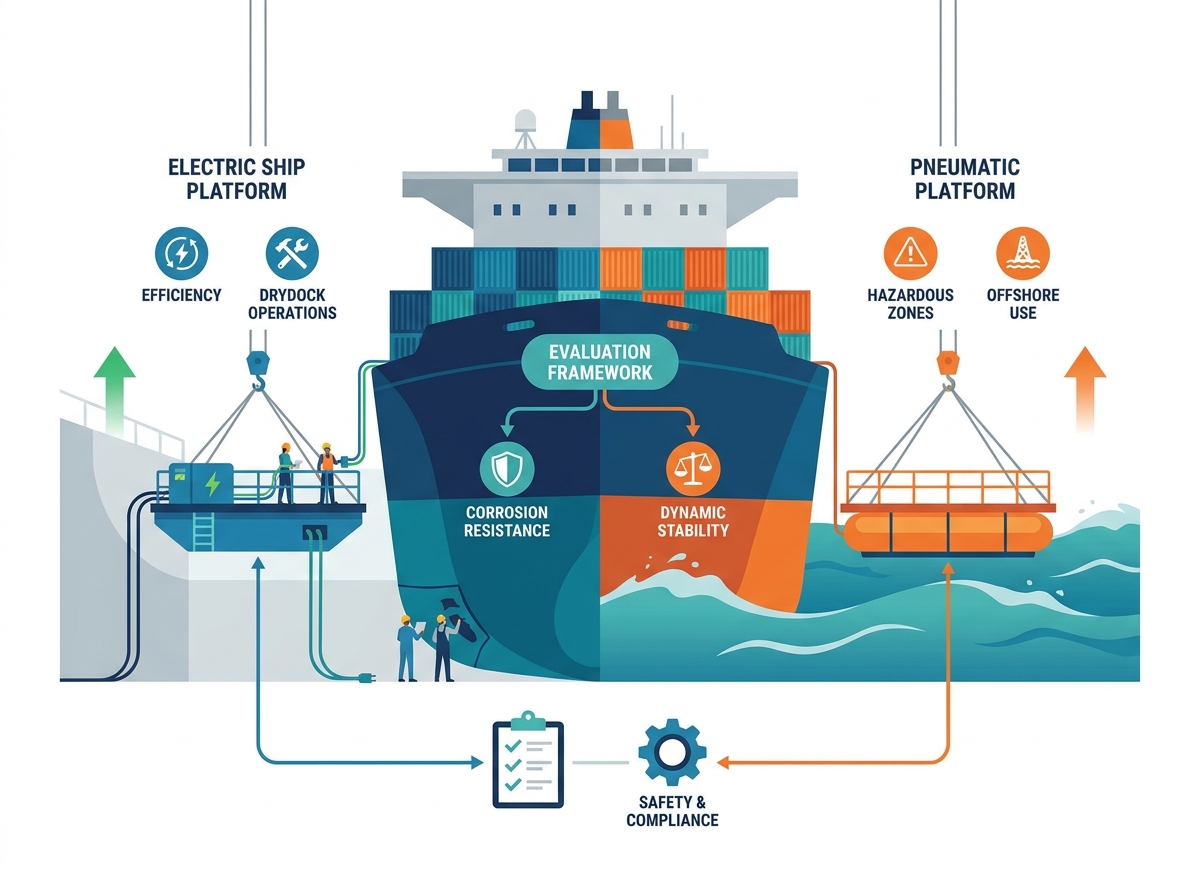
Selecting the correct drive system directly impacts your daily operational efficiency. Different shipyard environments demand distinct power sources. Understanding these operational categories helps you deploy the safest option.
An Electric Ship Platform remains the premier choice for high-frequency shipyard maintenance. These systems excel during large hull surface preparations. They dominate drydock operations due to their fast vertical transit speeds. Workers cover massive areas quickly. However, the maritime environment requires strict electrical safeguards. You must insist on IP-rated waterproof motors. Secure power routing prevents cable damage from sharp deck edges. Furthermore, the motors must match your specific shipyard voltage infrastructure perfectly.
Some operations prohibit electrical drive systems entirely. Offshore platforms and chemical tankers often contain hazardous ATEX zones. These highly combustible areas cannot tolerate any spark risks. Pneumatic and manual platforms provide the necessary safety here. They utilize compressed air lines or physical hand-cranks instead of electricity. They deliver slower vertical transit speeds compared to electric systems. However, they offer absolute reliability in highly explosive or hyper-corrosive environments.
Shipyards must also decide between modular and custom-engineered frame designs. Standardized modular platforms offer lower procurement costs. You can replace damaged floor sections or guardrails easily. They suit flat-sided cargo vessels perfectly. Conversely, custom-engineered platforms fit complex hull curvatures. Teams use custom designs to access intricate bulbous bows or specialized offshore rig columns securely.
Comparison Chart: Drive Systems for Marine Access | |||
Drive Type | Primary Environment | Key Advantage | Critical Consideration |
|---|---|---|---|
Electric | Drydocks, Harbor Ports | High-speed transit, efficiency | Requires IP-rated waterproofing |
Pneumatic | ATEX Zones, Oil Rigs | Zero spark risk, explosion-proof | Slower transit, requires air supply |
Manual | Remote Offshore Limits | Independent of external power | High physical labor requirement |
A rigorous evaluation framework transforms technical features into measurable maritime outcomes. You must scrutinize material selection, rigging mechanics, and compliance metrics carefully.
Maritime access equipment must survive extreme elemental exposure. You typically choose between marine-grade aluminum and hot-dip galvanized steel. Aluminum platforms offer incredible weight advantages. Rigging crews can maneuver aluminum components effortlessly across narrow ship decks. Aluminum inherently resists marine oxidation. Conversely, hot-dip galvanized steel provides superior impact resistance. Heavy maintenance often involves swinging sandblasters and bulky pneumatic tools. Galvanized steel absorbs these heavy physical impacts exceptionally well.
Standard building roofs differ drastically from maritime vessels. A standard Suspended Platform relies on flat surfaces. Ship decks feature immense clutter, pipes, and uneven sheer strakes. You must evaluate the specific adaptability of your outrigger beams. Parapet clamps must fit securely over uniquely shaped ship bulwarks. Your suspension mechanisms must accommodate these complex deck realities without damaging existing paint systems.
Maritime safety dictates strict engineering redundancies. You must treat EHS compliance as non-negotiable.
Secondary Safety Systems: Independent safety wire ropes must deploy automatically. Overspeed centrifugal brakes must engage instantly during any hoist malfunction.
Emergency Protocols: Platforms must include controlled manual descent features. Crews must reach the deck safely during sudden shipyard power failures.
Regulatory Alignment: Equipment must align completely with OSHA maritime safety standards (e.g., OSHA 1915). International marine access regulations also require extensive load-testing documentation.
Ship maintenance demands heavy equipment. You must calculate the necessary safe working load (SWL) accurately. Factor in personnel weight, heavy abrasive blasters, and wet paint materials. However, you cannot exceed the vessel deck's safe rigging point thresholds. High payload capacities must not create dangerously concentrated footprints on thin deck plating.
Operating machinery directly over water involves immense skepticism from safety officers. You must implement strict protocols to mitigate offshore deployment risks effectively.
Weather parameters dictate your operational windows constantly. You cannot operate a Marine Suspended Platform safely during high winds. Shipyards establish strict wind-speed limits for aerial operations. Gusts act like sails against solid platform floorboards. Implementing active motion-dampening techniques becomes mandatory. You must utilize specialized wire-rope stabilization methods. These tie-in mechanisms prevent the basket from swaying violently away from the hull.
Rigging complexities multiply quickly on commercial vessels. Ship decks present incredibly uneven surfaces. Crews often face heavy deck congestion from anchor chains, hatches, and cargo securing points. Calculating counterweights incorrectly on an uneven deck creates catastrophic tipping hazards. Rigging supervisors must design specific load distribution plans to avoid compromising structural deck integrity.
Continuous safe operations demand relentless daily inspections. Supervisors must conduct and document pre-shift checklists religiously. We recommend enforcing the following mandatory inspection protocol before every shift:
Inspect Wire Rope Integrity: Examine primary and secondary cables closely. Look for any broken wires, dangerous kinks, or severe corrosion spots.
Test Motor Brakes: Engage hoists briefly and cut power. Ensure the centrifugal brakes grab instantly without any platform slipping.
Verify Hoist Synchronization: Raise the basket several feet. Confirm both motors operate at identical speeds to maintain a perfectly level floor.
Check Electrical Connections: Inspect all control boxes and power cables. Look for any moisture ingress or compromised rubber weather seals.
Examine Hull Rollers: Verify soft-face rollers spin freely. Ensure they maintain safe contact with the vessel without scratching protective coatings.
Selecting the wrong equipment vendor introduces massive liabilities into your shipyard. You must vet manufacturers rigorously based on transparency, expertise, and proven maritime experience.
Engineering expertise forms your first vetting filter. Ask if the vendor provides project-specific rigging calculations. A reliable manufacturer will generate detailed CAD modeling for your specific vessel class. They do not rely on generalized terrestrial blueprints. They analyze your deck configurations and offer customized outrigger beam solutions.
Certifications and testing separate legitimate manufacturers from dangerous imitators. Demand transparent proof of recent dynamic and static load testing. Request documentation showing their motors surviving simulated salt-fog chamber tests. You must also collect third-party maritime compliance certificates before signing any purchase orders.
After-sales support dictates your long-term success. Evaluate the vendor's service level agreements (SLA) critically. Determine their exact timeframe for replacing critical components. A burnt-out hoist or damaged control box must arrive quickly. Extended parts delivery causes agonizing drydock delays. Every lost day in a drydock severely impacts shipyard profitability.
Take immediate action by drafting a comprehensive Request for Proposal (RFP). Include specific vessel blueprints in your document. Detail your exact environmental conditions and required payload capacities. Specify these operational details before buying a Ship Platform. This detailed RFP instantly filters out unqualified vendors who only understand basic residential construction.
Standard construction access equipment remains a severe liability within the shipping industry. Land-based scaffolding simply lacks the environmental resilience required for open-water environments. Selecting the right maritime access equipment demands strict technical alignment. You must balance drive-type suitability against rigorous EHS compliance regulations.
Decision-makers must prioritize vendor engineering transparency heavily. Opting for cheap, terrestrial-grade equipment introduces massive safety risks and guarantees short lifespans. Investing in robust anti-corrosion treatments and advanced stabilization techniques protects your crew immediately. It ensures reliable, long-term operational efficiency across thousands of maintenance cycles.
Do not compromise your next shipyard project with inadequate access solutions. We strongly urge you to consult directly with a specialized marine access engineer. Request a tailored site assessment of your facility or vessel today. Upgrading your access strategy guarantees safer workers and noticeably faster turnaround times.
A: A marine unit features specialized anti-corrosion treatments to survive constant salt spray. It utilizes custom parapet clamps and outriggers designed specifically for congested ship decks. Furthermore, it incorporates advanced stabilization systems to counter dynamic wind and unpredictable water movement.
A: Rarely. Operators heavily restrict their use to calm harbor waters or stable drydocks. Open-sea operations introduce severe vessel pitching and rolling. These extreme motion hazards, combined with unpredictable offshore power supply stability, make active sailing usage too dangerous.
A: Compliance heavily focuses on independent fall protection systems and mandatory secondary lifelines. You must provide rigorous load-testing documentation. The equipment must align completely with specific maritime scaffold guidelines, particularly regarding emergency manual descent capabilities and overspeed braking.
A: Manufacturers integrate soft-face hull rollers and specialized rubber bumpers into the basket design. Crews also utilize modular platform shapes to contour around unique curves. This maintains safe, continuous physical contact without scratching or damaging sensitive maritime paint coatings.


