 注: 建议图片大小150px*50px
丨
English
注: 建议图片大小150px*50px 


Views: 0 Author: Site Editor Publish Time: 2026-03-13 Origin: Site


When a project involves work at height—façade installation, exterior painting, curtain wall repair, window cleaning, or building maintenance—access equipment becomes a decision that directly affects safety, schedule, and cost. Many teams start by comparing scaffolding, boom lifts, and rope access, but in many real job sites the most practical solution is a Suspended Platform. It offers stable working space, flexible height adjustment, and efficient coverage along building façades without the time and material burden of building full scaffolding systems.
At Shenxi machinery Co., Ltd., we work with contractors and building owners who need reliable access equipment for both short-term construction and long-term maintenance. In our experience, the biggest value of a suspended platform is that it turns a difficult vertical job into a controlled workflow: workers stand on a stable platform, move smoothly along the façade, and complete tasks faster with less site disruption. In this article, we explain the key advantages of suspended platforms, where they perform best, and what to consider when selecting one for real-world projects.
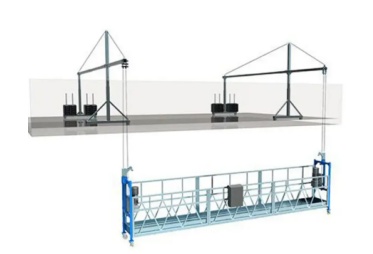
A suspended platform is a temporary or semi-permanent working platform hung from a building or structure using suspension mechanisms (such as outriggers, roof rigs, or support beams). It is raised and lowered by hoists and typically includes:
platform deck sections
hoists and safety locks
suspension ropes/wires
counterweights or anchoring systems
guardrails and safety protection elements
electrical control system
Suspended platforms are commonly used on high-rise and mid-rise buildings because they provide direct access to exterior surfaces without needing ground-based scaffolding all the way up.
One of the biggest advantages is efficiency. A suspended platform eliminates the need to build and dismantle large scaffolding structures for façade work. For many projects, this means:
shorter setup time
fewer materials on site
less labor hours spent on access preparation
faster start of actual façade work
Instead of building a fixed access structure, teams can install the platform, perform the job, and remove it with less disruption.
Suspended platforms can move vertically to match the exact working height needed. This is especially valuable when the work involves:
multiple façade levels
window rows
joints and sealant lines
panel-by-panel installation
inspection and repair work
Rather than relocating scaffolding stages or repositioning lifts repeatedly, a suspended platform allows controlled movement up and down along the same façade line.
Façade work often requires long horizontal coverage—especially for curtain wall systems, cladding, painting, insulation installation, or surface treatment. A suspended platform can provide:
stable working width
continuous access along a façade section
easier movement for teams and materials
Compared with small baskets or limited-space access tools, a platform allows multiple workers to operate in the same work zone with better coordination.
Many building exterior jobs are repetitive:
sealing and caulking
coating and painting
panel fixing
cleaning and polishing
inspection and replacement
Suspended platforms are well suited for repetitive workflows because they support:
stable working posture
consistent tool placement
efficient material handling
predictable movement patterns
This often improves daily productivity and reduces fatigue compared with less stable access methods.
A suspended platform provides a stable deck with guardrails, safety locks, and controlled movement. Compared with rope-only work, it gives workers:
a defined standing surface
easier tool handling
better balance and reduced fatigue
more controlled task execution
Safety is still dependent on correct installation and operation, but the platform design supports safer working conditions than many improvised or unstable access setups.
Scaffolding and large lifts can block building entrances, sidewalks, and logistics routes. Suspended platforms typically require less ground footprint. This is especially beneficial for:
city-center projects
occupied commercial buildings
hotels and residential towers
sites with limited space for staging materials
With reduced ground obstruction, building operations can continue more smoothly.
For tall buildings, scaffolding costs can increase dramatically. Suspended platforms often offer better cost efficiency because they:
reduce scaffolding material volume
lower labor hours for assembly/disassembly
reduce project time through higher productivity
allow easier repeated maintenance cycles
For building owners, suspended platforms also provide long-term value for ongoing façade cleaning and maintenance operations.
Suspended platforms are not only for construction. They are widely used for long-term building operation tasks such as:
façade inspections
sealant repair
glass replacement preparation
cleaning and maintenance
surface refurbishment
This makes them a useful solution for both contractors and facility management teams.
Access method | Strength | Limitation | When suspended platform is better |
Scaffolding | stable, strong load | slow to build, high cost for high-rise | faster setup and less site congestion |
Boom lift | quick positioning | limited reach for tall façades | better for full-height continuous access |
Rope access | flexible, low equipment | limited work platform, fatigue | better for longer tasks and teamwork |
Suspended platform | stable, adjustable, efficient | needs correct rigging and safety control | best for façade workflows and repetitive tasks |
Suspended platforms are widely used wherever teams need safe, repeatable access to vertical or hard-to-reach exterior surfaces. They are especially common in high-rise and mid-rise projects because they can cover long façades efficiently without the footprint and setup time of full scaffolding. Typical applications include curtain wall installation and adjustment, where crews need precise positioning to align panels and complete final fasteners; exterior painting and coating, where stable working height improves surface preparation and finish consistency; and façade renovation and repair, such as replacing damaged panels, fixing corrosion points, or restoring protective layers.
They are also widely used for window cleaning and replacement preparation, because platforms provide a stable workface for removing old sealant, cleaning frames, and staging glass handling. In addition, suspended platforms support sealing and joint repair work, where technicians must follow long vertical joints and apply sealant evenly; insulation and cladding installation, where workers need steady access to multiple façade zones; and exterior inspection and maintenance, including crack checks, anchor inspections, and periodic façade safety reviews. In short, suspended platforms deliver the most value on buildings with long vertical façades and repeatable work zones, where crews move systematically floor by floor.
To gain the full advantages of suspended platforms, buyers should evaluate selection based on real job conditions—not just platform length.
Platform length and configuration
Different projects require different working widths, modular lengths, and end sections. A longer platform may increase productivity, but it also increases handling complexity and needs proper suspension planning.
Rated load and worker capacity
Match the rating to the actual working load: number of workers, toolboxes, coating materials, sealant buckets, replacement parts, and any lifting or repositioning workflow. Underestimating load is a common safety and efficiency risk.
Hoist system and safety locks
Reliable hoists and effective safety locks are essential for stable lifting, controlled positioning, and safe stopping under abnormal conditions. These systems directly affect operator confidence and daily productivity.
Suspension method and roof conditions
Outriggers, roof rigs, counterweights, and anchoring options must match building structure, parapet height, roof layout, and access constraints. Suspension design is not “one-size-fits-all.”
Power supply and control needs
Confirm site power availability, control system simplicity for operators, and emergency descent planning. A good system is not only efficient in normal operation, but also predictable and safe during unexpected power loss or emergency scenarios.
So, what are the advantages of a Suspended Platform? The key benefits include efficient high-rise access without full scaffolding, flexible height control, strong façade coverage, improved productivity for repetitive tasks, stable working space for safer operation, reduced ground obstruction, and cost efficiency for tall building projects. It is a practical solution not only for construction, but also for ongoing building maintenance and inspection.
To learn more about suspended platform solutions and how to select the right configuration for your project, you are welcome to contact Shenxi machinery Co., Ltd. for more information.
It is mainly used for façade work such as curtain wall installation, exterior maintenance, repair, painting, and window cleaning on mid- and high-rise buildings.
It can provide a more stable working surface and guardrail protection, but safety still depends on correct rigging, inspection, and operating procedures.
Because scaffolding becomes expensive and time-consuming at height, while suspended platforms offer faster setup and flexible vertical movement.
Choose based on façade width, worker count, material load, and workflow. Platform length and rated capacity should match real job needs.


