 注: 建议图片大小150px*50px
丨
English
注: 建议图片大小150px*50px 


Views: 0 Author: Site Editor Publish Time: 2026-03-21 Origin: Site


Working at height always demands respect for the equipment, the environment, and the task itself. When a project depends on a Suspended Platform, two limits matter more than most users first realize: how much the platform can safely carry, and how wind affects stability during operation. These two factors are closely connected. A platform that performs well under calm conditions can become much harder to control when wind pressure rises, and a load that looks acceptable on paper can create real risk if material distribution, worker movement, and weather are not considered together. At Shenxi Machinery Co., Ltd., we have seen that buyers, contractors, and site managers often focus on lifting height, platform length, or motor configuration first.
A suspended platform is designed to provide a reliable working position on building façades, towers, chimneys, bridges, and other vertical structures. It allows workers to access high or hard-to-reach surfaces for construction, repair, cleaning, painting, insulation, installation, and maintenance. Because the platform is suspended by wire ropes and supported by a roof-mounted or parapet-mounted suspension mechanism, it is naturally more sensitive to external conditions than fixed access systems.
That sensitivity is exactly why wind speed and load capacity deserve serious attention. Load capacity affects whether the platform, hoists, ropes, safety locks, and suspension mechanism are working within their intended limits. Wind speed affects how stable the platform remains during lifting, lowering, and stationary work. If either factor is ignored, the result may be reduced productivity at best and a serious safety incident at worst.
Many users assume load capacity means the total weight the platform can hold before anything fails. In practice, the meaning is more specific and more disciplined than that. Rated load capacity refers to the maximum safe working load defined by the design of the suspended platform. This includes workers, tools, materials, accessories, and anything else placed on the platform during operation.
That means load capacity is not just about the workers standing on the deck. It also includes:
Power tools and hand tools
Buckets, sealants, paints, glass fittings, or installation parts
Cable reels or hoses
Temporary storage of façade materials
Personal protective equipment and additional gear
Once all of these are added together, the real working load can become much higher than expected.
Another point that often gets overlooked is dynamic load. A platform may be within rated load when standing still, but movement inside the platform changes the load pattern. Workers stepping quickly to one side, shifting heavy materials, or pulling external components inward can temporarily increase stress on certain points. That is why proper load distribution matters just as much as total load.
On real jobsites, the platform is rarely loaded in a perfectly balanced way. One worker may stand near a hoist end while another handles material near the center. A stack of tools may be placed at one side simply because it is convenient. The result is uneven loading, and uneven loading can reduce operational stability even before the rated limit is reached.
We usually advise customers to think in terms of safe working margin rather than theoretical maximum load alone. A platform used close to its rated capacity every day may still be compliant, but it leaves less room for changing site conditions, small operator mistakes, or unplanned material additions. A more controlled working load often improves both safety and workflow.
The table below gives a simple way to think about what contributes to the total platform load.
Load Component | Typical Examples | Why It Matters |
Personnel | Operators, technicians, inspectors | Forms the base working load |
Tools | Drills, grinders, sealant guns, hand tools | Often underestimated in planning |
Materials | Paint, panels, glass hardware, insulation | Can quickly raise total load |
Accessories | Cables, hoses, buckets, temporary fixtures | Add weight and affect balance |
Movement Impact | Shifting positions, handling large items | Changes force distribution dynamically |
A platform that looks lightly loaded from the ground may still be approaching its operational limit if the distribution is poor or the materials are concentrated in one area.
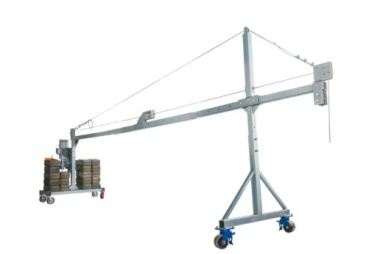
Wind does much more than make workers uncomfortable. It changes the way the suspended platform behaves in motion and while stationary. Because the platform hangs on wire ropes, it can sway, twist, drift, or oscillate under wind pressure. The larger the platform and the greater the exposed surface area of workers, tools, and materials, the more significant this effect becomes.
Even moderate wind can create operational difficulty if the façade shape causes turbulence. Corners, recessed structures, open tower faces, and varying building geometry can all produce unpredictable gusts. Wind may also behave differently at higher elevations than at ground level. A calm street-level impression does not guarantee calm working conditions on the side of a tall structure.
When wind pressure acts on the platform, several things may happen:
The platform may swing away from the building
Positioning may become less accurate
Workers may need more effort to stabilize themselves
Contact with the façade may become irregular or harder to control
Materials may shift or catch the wind
Platform components may experience added stress
This is why wind speed is not just a weather note. It is an active operating condition.
A common mistake is to think only the platform itself is exposed to wind. In reality, the full wind profile includes the platform, workers, tools, packaging, materials, and even clothing. A compact repair task may create relatively little wind resistance. By contrast, installing large panels, handling insulation boards, or working with sheeting can dramatically increase the effective wind load.
In other words, the job being performed can change the way wind affects the platform, even when the platform model stays the same.
For example, two suspended platforms at the same building height may face very different risks:
Job Type | Wind Sensitivity | Main Reason |
Sealant repair | Moderate | Small tools, limited exposed materials |
Window cleaning | Moderate to high | Repetitive motion and wet surfaces |
Painting work | Moderate | Containers and hoses add complexity |
Panel installation | High | Large materials catch wind easily |
Insulation or cladding work | High | Broad, lightweight surfaces increase drag |
This is why wind policy should be tied not only to equipment specifications but also to the actual application.
Wind speed and load capacity are often discussed separately, but they interact in real operation. A heavily loaded platform is generally less forgiving under wind influence because the system is already working closer to its intended limit. On the other hand, a lightly loaded platform may still become unsafe if wind creates violent swinging or if large materials increase the wind-catching surface.
The safest operational mindset is to evaluate both together. A suspended platform carrying workers plus bulky installation materials in rising wind is not simply dealing with “load” and “weather” as two separate conditions. It is dealing with a combined stability challenge.
This is especially important when handling long or flat materials. Even if the actual weight is manageable, those materials can behave like sails. A crew may feel they are within the rated capacity of the platform, but the wind effect can make the working condition unacceptable.
A Suspended Platform delivers real value when it is used within clearly understood limits. Wind speed and load capacity are not secondary details to review only after equipment arrives on site. They are central to safe planning, stable operation, and long-term performance. The more demanding the project, the more important these factors become. At Shenxi Machinery Co., Ltd., we always encourage customers to think beyond the platform itself and look at the full working condition: the building, the task, the crew, the materials, and the weather. That is how better decisions are made. If you are evaluating access equipment for façade work, maintenance, or installation, learning more about the right suspended access system for your project can help you improve both safety and efficiency. Contact Shenxi Machinery Co., Ltd. to explore practical solutions and get professional support for your suspended platform applications.
Wind speed affects platform stability, worker control, material handling, and positioning accuracy. Even if the equipment is working normally, stronger wind can make operation unsafe.
Load capacity includes the total working load on the platform, including workers, tools, materials, accessories, and any other items placed on the deck.
Yes. A platform may look lightly occupied but still be overloaded if heavy tools, consumables, or stored materials are added, especially when weight is unevenly distributed.
The best approach is to combine proper equipment selection with operator training, daily inspection, real load calculation, and continuous wind condition monitoring.


