 注: 建议图片大小150px*50px
丨
English
注: 建议图片大小150px*50px 


Views: 0 Author: Site Editor Publish Time: 2026-03-19 Origin: Site


When infrastructure owners talk about safety, speed, and cost in maintenance projects, the conversation often ends up focusing on access. You can have the best technicians and the best repair materials, but if the work area is difficult to reach—under a bridge deck, around a cable-stayed tower, or along a wind turbine blade—progress slows, risk increases, and quality becomes harder to control. That is why the suspended platform has become such a valuable tool in modern maintenance engineering. Unlike traditional scaffolding, suspended platforms can be deployed quickly, repositioned efficiently, and adjusted to complex structures. They allow crews to work closer to the surface with stable positioning, which improves both safety management and work precision.
From our perspective at Shenxi machinery Co., Ltd., we have seen suspended platforms evolve from simple façade access tools into specialized systems for critical infrastructure. Bridge maintenance and wind turbine repair are two areas where innovation in suspended access is creating measurable value. Both environments share the same challenge: large structures, difficult geometry, and high exposure to wind and weather.
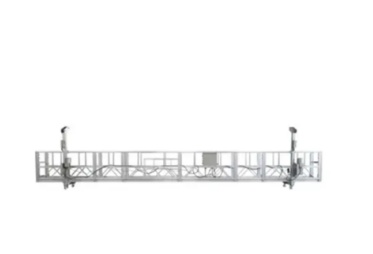
A suspended platform is an elevated work platform supported by wire ropes or suspension mechanisms, typically powered by hoists that allow vertical movement and controlled positioning. Compared with fixed scaffolding or heavy mobile lifts, a suspended platform offers:
flexible access along large surfaces
fast deployment and repositioning
reduced ground footprint
adaptable configurations for complex geometry
the ability to work close to the structure with controlled stability
For bridges and wind turbines, where access zones can be narrow, high, or located above water or uneven terrain, this flexibility becomes a major project advantage.
Bridge maintenance and wind turbine repair both push access equipment to the limit, because the work areas are large, exposed, and often impossible to reach safely with ordinary ladders or mobile lifts. For bridges, crews must cover long spans and wide underside areas, often above water or active traffic lanes where ground-based support is restricted. Cable-stayed systems and towers add complex geometry, so technicians need a solution that can follow curved or angled surfaces without constant re-rigging. At the same time, traffic control, public safety, and strict site rules make it difficult to build and keep large scaffolding in place.
For wind turbines, the challenge shifts to height and weather. Technicians work at significant altitude with rapidly changing wind conditions, while blades present curved surfaces that require stable positioning for inspection, grinding, filling, and coating. Space around nacelles and towers is limited, and every extra hour of downtime directly affects power generation revenue. Safety expectations are also very high, including fall protection and rescue readiness. In both cases, suspended platforms bring people, tools, and materials to the workface efficiently—without the time and footprint of full scaffolding.
One of the most common innovations is using suspended platforms as modular under-deck systems. These platforms can run along the underside of the bridge deck and provide stable access for:
concrete crack inspection and sealing
steel corrosion assessment and touch-up painting
bolt tightening and joint checks
bearing and expansion joint maintenance
cable inspection in cable-stayed structures
Compared with scaffolding, under-deck suspended access reduces setup time and minimizes disruption to traffic below.
Cable-stayed bridges often require access to pylons, anchorage zones, and cable surfaces. Suspended platforms can be configured with:
adjustable rigging to follow tower geometry
platforms designed for narrow anchorage work zones
multi-point suspension for stability
This allows targeted repair and inspection without full-tower scaffolding.
Coating work is sensitive to access stability because surface preparation and paint thickness require consistent technique. Suspended platforms help by providing:
steady working height adjustment
close surface access for blasting and coating
controlled movement along long spans
In long-span bridges, the reduction in access setup time can be significant.
Not every bridge project needs full under-deck access. Modular suspended platforms can be deployed for localized repairs like:
patching spalled concrete sections
replacing small steel components
installing sensors or monitoring equipment
sealing leaking joints
This approach supports efficient “spot maintenance” without large-scale access systems.
Wind turbine blades require inspection for:
leading edge erosion
lightning strike damage
surface cracks
coating failures
Suspended platforms can be configured to follow blade geometry, enabling technicians to work along the blade length with better stability than rope-only access methods.
When servicing tower exterior components, cable routing, or external sensors, platforms allow:
controlled vertical movement along the tower
safer material handling compared with rope-only work
better working posture for technicians
This can reduce fatigue and improve repair quality.
In many wind farms, conditions change quickly. Some projects adopt hybrid suspended systems that combine:
suspended platforms
fall protection and rope access backup
stabilization methods to reduce sway
This helps crews maintain productivity while still respecting strict wind safety thresholds.
In wind energy, downtime is expensive. Suspended platforms can reduce mobilization time compared with heavy cranes or full temporary structures, especially when:
access roads limit crane transport
site terrain complicates lifting
multiple turbines need repeated minor repairs
Fast setup can mean faster return-to-service.
Factor | Bridge maintenance | Wind turbine repair |
Typical access zone | under-deck, pylons, cables | blades, tower exterior, nacelle |
Key challenge | long-span coverage + traffic constraints | altitude + wind variability |
Platform requirement | modular length, stable horizontal travel | stability, curved surface access |
Productivity focus | minimize disruption + efficient coverage | reduce downtime + fast deployment |
Safety emphasis | over-water/traffic fall protection | wind safety + rescue readiness |
Platforms reduce repeated climbing and repositioning, allowing continuous work along surfaces.
Stable positioning improves precision for coating, sealing, grinding, and inspection tasks.
Minimal ground structure is needed, which is important over roads, rivers, and sensitive site terrain.
Suspended platforms can be integrated with standardized safety procedures, including:
fall arrest systems
load rating control
emergency descent and rescue planning
inspection and maintenance routines
To choose the right system, we recommend confirming:
number of workers and tools on platform
required length and width
material handling requirements
vertical travel distance
horizontal travel or reposition approach
how the platform will navigate structural geometry
wind exposure
corrosion environment (marine bridges, offshore wind)
temperature and weather variability
guardrails and toe boards
emergency stop and descent systems
rope and hoist inspection plan
anchoring strategy and structural verification
Underestimating wind and sway impacts
Choosing platform size without considering real tool loads
Ignoring corrosion protection in marine environments
Lacking a clear rescue and emergency descent plan
Skipping operator training and inspection routines
Bridge maintenance and wind turbine repair are two sectors where access technology can directly determine project success. A well-designed suspended platform solution allows crews to reach difficult zones safely, work more efficiently, and deliver higher-quality inspection and repair outcomes. In bridges, suspended platforms enable under-deck and pylon access with less disruption and faster setup than scaffolding. In wind turbines, they support blade and tower work with improved stability and faster deployment, which is critical for reducing downtime. The most innovative projects treat suspended platforms not as generic equipment, but as engineered access systems tailored to structure geometry, work methods, and environmental conditions.
At Shenxi machinery Co., Ltd., we provide suspended platform solutions designed for demanding infrastructure maintenance environments. If you want to explore the right suspended platform configuration for your bridge project or wind turbine repair workflow, you are welcome to contact us to learn more about suitable system options, safety features, and practical deployment guidance.
A suspended platform is used to access under-deck areas, pylons, cables, and coating zones for inspection, repair, cleaning, and painting with reduced traffic disruption and faster setup.
Suspended platforms provide controlled access to blades, towers, and nacelle exteriors, improving technician stability and reducing downtime compared with slower access methods.
They can be safer for many tasks because they provide a stable working surface, guardrails, and improved tool handling, but safety still depends on correct design, anchoring, inspection, and operator training.
Key factors include load capacity, platform size, movement range, wind exposure, corrosion resistance, anchoring strategy, emergency descent systems, and site-specific safety planning.


